



Packaging is not just about wrapping the products and selling them. It is about attracting customers to your products to gain sales. But it can be hard for businesses to get attention for their products in busy stores; this is where display boxes come in.
Display boxes help brands showcase their products in busy areas, creating impulse purchases. However, several types of display packaging boxes are available, and the most popular are counter and floor display boxes.
Choosing the right display box for your business can help attract customers and increase sales. In this guide, we will walk you through which option is best for your brand: counter display boxes or floor display boxes.
What are Counter Display Boxes?

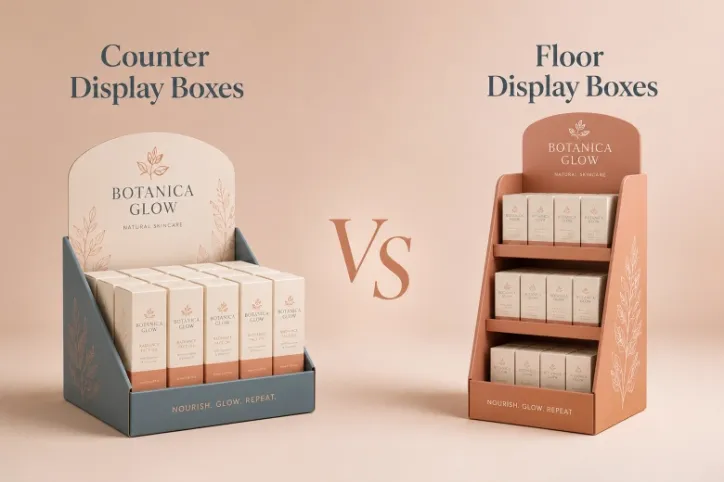
Counter display boxes are the most popular type of display boxes that are used by various industries to showcase their product effectively. These boxes are specialized containers that help to display products on check-out counters and retail shelves.
They are mostly used to display daily-use products on counters, such as small boxes of mints, lip balm, toys, and more. They sit at eye level and often tempt shoppers into making an impulse purchase at checkout.
What are Floor Display Boxes?
Floor display boxes are large in size and grab customers’ attention instantly. They are mostly used in high-traffic areas. They are perfect for displaying multiple products. When you go shopping, you must have seen them, as they carry a variety of products at once, such as cereal boxes, chips, and promotional items.
Quick Comparison of Counter Display Boxes vs Floor Display Boxes
The simplest difference between them is the placement and scale. A countertop display is designed to sit on a counter or checkout line and is smaller in size. It is designed for close-range buyer interaction. Whereas floor displays are freestanding and placed directly on the retail floor, often found in aisles, promotional zones, or endcap areas.
The main question is not which one is better overall; it’s which one fits your product needs.
| Feature | Countertop Displays | Floor Displays |
| Footprint | High-value, limited register/counter space. | Versatile retail floor space (aisles, endcaps). |
| Product Type | Lightweight, small items (cosmetics, lip balms, small electronics). | Bulky, heavy, or high-volume items (beverages, multi-packs). |
| Capacity | Low volume; requires frequent restocking. | High volume; holds mass inventory for major promos. |
| Structural Style | Simple header cards with a stepped tray or dividers. | Multi-tiered shelves, peg hooks, or dump bin setups. |
| Shipping Efficiency | Simpler and smaller cartons. | Needs complex structure planning. |
| Cost | Usually Lower. | Usually Higher. |
When is a Counter Display Box Better?
A counter display works best when products need to be placed right where customers can easily reach them. This setup is perfect for impulse buys, small promotional items, travel-size products, beauty samples, confectionery, accessories, and other lightweight packaged goods. Since it sits close to the customer, it doesn’t need to be large to grab attention, yet it still performs effectively.
It’s also a smart choice when retail space is limited. In smaller stores, a compact display placed at the checkout counter or payment area often works better than a bulky floor display. This format suits products that are small, lightweight, and meant for quick, on-the-spot buying decisions.
When is a Floor Display Box Better?
A floor display is a better choice when stronger visibility, higher product capacity, or more space for branding is needed. It works well for larger promotions, multi-SKU campaigns, seasonal launches, beverages, snacks, pet products, personal care items, and other retail goods that need more visual impact.
Since it stands on the floor and is visible from a distance, it catches customer attention earlier in the shopping journey. It also provides more room for branding, organized shelving, and promotional messaging. For brands aiming to stand out in busy aisles or high-traffic promotional areas, a floor display is often the more effective option.
If broader in-store merchandising solutions are needed, the retail display solutions page offers additional options for retail structures.
How Visibility & Shopper Behavior Affect The Choice
A counter display is most effective when the goal is to grab attention at close range, usually right near the final point of purchase. A floor display, on the other hand, works better when the aim is to attract shoppers from a distance and influence them earlier in their in-store journey.
This difference is important because buying behavior varies with store layout. In some stores, counter space is very limited, and only select products can be placed there. In others, brands get more value from a larger floor display positioned in a promotional area where it can be seen as customers move through the aisles.
If you want to improve your brand visibility, explore our detailed guide on how to design countertop display boxes that attract attention and boost product exposure.
Which One Costs More? Floor Or Counter Display?
In terms of price, floor display boxes cost more than counter display boxes. This is because they consume more material, have larger dimensions, and require stronger support than counter display boxes.
Counter displays, on the other hand, are smaller, use less material, and are easier to manufacture, making them a more budget-friendly option for brands seeking simple in-store presentation solutions.
If you are evaluating the budget, you must visit our guide to the cost of display boxes for a better understanding, as it covers all aspects of each display box.
Quick Question You Should Ask Yourself Before Making A Decision
Before deciding which display box type you should choose for your business needs, ask these practical questions:
- How many products will be displayed at once?
- How heavy is the product?
- How do you want your product to be displayed? Near checkout lines or in an aisle?
- How much retail space is available?
- What are the main goals? Visibility, impulse purchasing, or stock capacity?
- Does your product need a stronger branding space?
- What are the packaging and shipping requirements?
Answering these questions will help you evaluate whether countertop display boxes or floor displays are the best.
Final Thoughts
In conclusion, choosing the right display box is not just a packaging decision; it is a marketing strategy. Counter display boxes and floor display boxes each have unique advantages, and the best choice depends on your product, store layout, and customer behavior.
Counter displays are ideal for quick impulse purchases, while floor displays provide larger visibility and can showcase multiple products together. Investing in thoughtful display packaging can improve engagement, brand perception, and sales.
Remember, it is not just about holding your product; it is about presenting it in a way that attracts attention and creates a positive shopping experience.
Frequently Asked Questions
What is the main difference between counter display and floor display boxes?
Counter display boxes are small, placed on counters for easy reach, while floor display boxes are larger, freestanding units that attract attention from a distance in store aisles.
Which one is better for impulse purchases?
Counter display boxes are better for impulse purchases because they are positioned at checkout areas or high-traffic spots, making products easy to grab quickly without much thought.
Can a brand use both formats for one campaign?
Yes, a brand can use both formats. Floor displays draw attention and showcase multiple products, while counter displays encourage last-minute, impulse purchases near the point of sale.
