


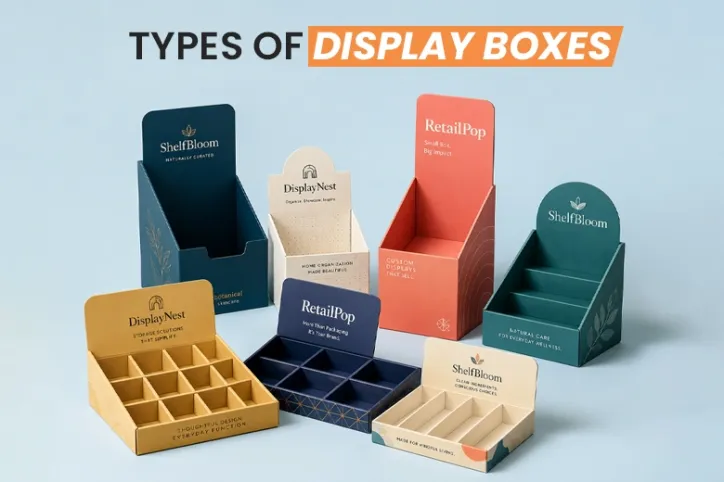

Have you ever seen multiple products presented together in a retail store, on a checkout counter, or directly on a shelf? You were likely looking at some form of retail display packaging.
Display boxes are designed to hold and present multiple product units while keeping them organized and accessible to shoppers. Depending on the structure, they can sit on a counter, shelf, floor, pallet, or hanging display location.
The important part is choosing a display format that matches the product, available retail space, number of units, weight, replenishment process, and amount of customer access required.
This guide explains the main types of display boxes and how to choose the appropriate format for your product.
What Are Display Boxes?
Display boxes are packaging structures designed to present products directly in a retail environment while keeping multiple units organized and accessible.
Unlike conventional product boxes that primarily enclose an individual item, display packaging is designed around merchandising. It can provide a defined space for multiple products and may include open fronts, headers, compartments, perforated panels, dividers, or other features that improve product visibility and access.
Display packaging may also be described using terms such as POS (point of sale), POP (point of purchase), PDQ, shelf-ready packaging, counter display, or retail display. These terms do not always describe the same structure; some refer to where the display is placed, while others describe its retail workflow or construction.
For a broader overview, see our guide on what display boxes are.
What Materials Are Used for Display Boxes?
The material should be selected according to the product weight, display size, expected handling, retail environment, and desired presentation.
Common options include:
- Cardboard/Paperboard: Suitable for lightweight products and compact countertop or shelf displays where high-quality printing is important.
- Corrugated Board: Provides additional structural strength and is commonly used for larger displays, heavier products, and shipping-oriented display structures.
- Kraft Stock: Provides a natural paper-based appearance and can suit brands looking for an understated or organic visual style.
- Rigid Board: Provides a more substantial structure for premium presentation, although it is less commonly used for large floor or high-volume display structures.
You can learn more about selecting the best material for display packaging boxes based on your product and display requirements.
Types of Display Packaging Boxes
Display boxes can be classified in several ways. Some names describe where the display is placed, while others describe how it is assembled, how products are accessed, or how the products are supported.
This distinction matters because the same display can belong to more than one category. For example, a display could be a countertop display made from corrugated board with a die-cut front and internal dividers.
The following are the main display formats and configurations to consider.
Countertop Display Boxes
Countertop display boxes are compact units designed to sit on counters, checkout areas, service desks, or other small retail surfaces.
They are generally suited to smaller products that customers can easily pick up, such as cosmetics, snacks, supplements, accessories, and other grab-and-go products.
Their main advantage is their small footprint. If counter space is limited, the display needs to provide product visibility without interfering with the checkout or service area.
Stand-Up Display Boxes
Stand-up display boxes are designed to remain upright on a floor, table, or other supporting surface. Their vertical orientation gives the brand additional display height without requiring a large horizontal footprint.
They can be used for packaged goods, toys, accessories, promotional products, and other merchandise that benefits from an elevated presentation.
The appropriate board construction depends on the product weight, number of units, display dimensions, and expected handling.
Floor Display Boxes
Floor display boxes are freestanding structures designed to hold products directly on the retail floor.
They are useful when a brand needs more product capacity or greater visibility than a countertop or shelf display can provide. Common applications include seasonal promotions, product launches, promotional campaigns, and high-traffic retail areas.
When designing a floor display, consider its footprint, loaded weight, base stability, number of shelves or product facings, and how easily store employees can replenish it.
End-Cap Displays
An end cap is primarily a retail placement, rather than a specific box construction. It refers to merchandise displayed at the end of a retail aisle.
A custom display designed for an end cap may use shelves, trays, tiers, headers, or other structures depending on the products and available space.
Because end caps are positioned in high-visibility areas, the display needs to work within the retailer’s required width, height, depth, and merchandising guidelines.
Pop-Up Display Boxes
Pop-up display boxes are designed to open or assemble into a display format with minimal setup.
They can be useful for temporary retail programs, trade shows, exhibitions, promotional events, and campaigns where the display needs to be transported or stored efficiently.
The main considerations are assembly time, portability, packed dimensions, display stability, and how the structure behaves once loaded with products.
Dispenser Boxes
Dispenser boxes combine product storage and controlled product access. Depending on the design, customers can take products individually through an opening or dispensing area.
They are commonly used for products such as tissues, sachets, snacks, promotional samples, and other individually distributed items.
The dispensing opening should be designed around the product dimensions so products can be removed easily without causing the remaining units to collapse or become difficult to access.
Power Wing Displays
Power wing displays, also called sidekick displays, are designed to use additional retail space alongside shelves or end-cap areas.
They are particularly useful for smaller products that can be hung, clipped, or organized vertically. Common applications include accessories, toiletries, snacks, and other lightweight merchandise.
The mounting method, product weight, number of units, and retailer’s fixture requirements should be considered before selecting this format.
Perforated Display Boxes
Perforated display boxes use planned tear-away or fold lines that allow part of the packaging to be removed or opened to create a retail display.
This format can be useful when products need to travel to the store in a protected configuration and then be converted into a more accessible display.
The perforation pattern should be engineered so the removable section comes away cleanly without weakening the portion of the box that remains in use.
Shelf-Ready Packaging Boxes
Shelf-ready packaging (SRP) is designed to simplify the transition from transport and stocking to retail presentation.
Instead of removing individual products from a shipping carton and arranging them manually, a retailer can place the prepared package directly on the shelf and remove or open a designated section when required.
This can reduce setup and replenishment work when the packaging is designed around the retailer’s shelf dimensions and stocking process.
PDQ Display Boxes
PDQ is commonly used for retail-ready display packaging designed for quick placement and product access. The exact structure can vary, so PDQ should not be treated as one fixed box shape.
A PDQ display may be designed for a counter, shelf, or other retail position. What makes it different is primarily the way products are arranged and prepared for retail presentation.
When choosing a PDQ structure, consider product count, product weight, replenishment requirements, shelf footprint, and how much assembly store employees need to perform.
Pallet Display Boxes
Pallet display boxes are large display structures designed to hold higher volumes of products and can be placed directly on a pallet or retail floor.
They are useful for high-volume products, seasonal promotions, warehouse retail environments, and products that need to remain in a large quantity while being accessible to shoppers.
Pallet displays require particular attention to loaded weight, base strength, footprint, pallet dimensions, transport, and replenishment.
Hang Tab Display Boxes
Hang tab boxes include an integrated tab or hanging feature that allows the package to be displayed on peg hooks or similar retail fixtures.
They are suitable for smaller and lightweight products such as accessories, tools, cosmetics, and electronics accessories where vertical hanging space is available.
Front Cut-Out Display Trays
Front cut-out display trays use a lowered or partially open front to make the products easier to see and access.
They can be useful for cosmetics, accessories, packaged goods, and other products where shoppers need to see the product without removing the entire package.
The height of the front opening should be balanced against product stability. A lower front improves visibility and access, while a higher front provides additional support.
Display Boxes With or Without Dust Flaps
Dust flaps are a configuration feature rather than a completely separate display type.
A display with protective flaps can provide additional coverage for products that need to remain cleaner during storage or retail handling. An open display without those flaps provides faster customer access.
The decision depends on the product, retail environment, turnover rate, and how much access shoppers need.
Kraft Display Boxes
Kraft describes the material, not a separate structural display type.
Kraft can be used for countertop displays, shelf displays, trays, and other structures when its appearance and material characteristics fit the application.
Its natural paper appearance can work particularly well for handmade, organic, artisanal, or minimalist brands. If sustainability is part of your packaging strategy, consider the specific material composition and local recycling requirements rather than assuming that every kraft package is automatically more sustainable.
You can explore our kraft boxes for additional packaging options.
Pre-Roll and CBD Display Boxes
Pre-roll and CBD displays are application-specific packaging formats rather than one universal display structure.
The appropriate design depends on the product, retail environment, applicable regulations, package dimensions, and required product information.
For regulated products, packaging should be developed with the applicable federal, state, and local requirements in mind rather than assuming that one display format satisfies every market.
Explore our pre-roll display boxes and CBD display boxes for product-specific options.
How to Choose the Right Display Box Type
The right display box depends on more than the product itself. You should consider where the display will be placed, how many units it needs to hold, how customers will interact with the products, and how often the display will need to be replenished.
Product Weight and Dimensions
Start with the product.
Measure the product’s length, width, height, weight, and any irregular features that affect how it will sit inside the display.
Lightweight products may work well in countertop, hanging, or open-tray formats. Heavier products may require a stronger base, deeper side walls, reinforced construction, or a corrugated structure.
Retail Placement
Where will the display actually sit?
- Counter: Choose a compact format that fits within the available counter footprint.
- Shelf: Consider shelf depth, height, product visibility, and replenishment.
- Aisle end: Make sure the structure meets the retailer’s required footprint and provides sufficient visibility.
- Floor: Consider stability, loaded weight, height, and customer access.
- Pegboard or slatwall: A hanging or hang-tab format may make better use of vertical space.
- Pallet: Consider pallet dimensions, transport, loaded weight, and high-volume replenishment.
The retail location should be established before finalizing the display dimensions.
Product Count and Number of Facings
A display holding ten products has different structural requirements from one holding fifty.
Consider:
- Number of units per display
- Number of SKUs
- Number of product facings
- Product weight
- Replenishment frequency
- Whether different SKUs need separate lanes or compartments
For multiple SKUs, dividers or defined product lanes may help keep products organized and make replenishment easier.
Customer Access
Think about how customers will interact with the products.
If shoppers need to pick up individual units quickly, an open-front tray, countertop display, dispenser, or hang-tab format may be appropriate.
If products need more protection or controlled access, a display with higher front walls, dust flaps, compartments, or product holders may be more suitable.
Setup and Replenishment
A display can look excellent but still be impractical if store employees need too much time to assemble or restock it.
Consider:
- How the display arrives at the store
- Whether it arrives pre-packed
- How many assembly steps are required
- How products are loaded
- How quickly employees can replenish the display
- What happens when the display becomes partially empty
This is particularly important for high-volume retail programs where small differences in setup or replenishment time can become significant across many stores.
Shipping and Storage
If the display is shipped to retailers before being assembled, consider its packed dimensions and shipping configuration.
A flat-packed or collapsible structure may reduce storage and transportation requirements compared with a permanently assembled display.
The display also needs to remain structurally sound after reaching the retail environment. Product weight, handling, transport, and assembly should therefore be considered during the design stage.
Display Box Types at a Glance
| Display Type | Primary Purpose | Best For | Main Consideration |
|---|---|---|---|
| Countertop Display | Compact point-of-sale presentation | Small impulse products | Limited counter space |
| Stand-Up Display | Upright product presentation | Packaged goods, toys, accessories | Stability and product weight |
| Floor Display | Freestanding retail presentation | Promotions and larger product quantities | Footprint and loaded weight |
| End-Cap Display | High-visibility aisle placement | Promotions and launches | Retailer space requirements |
| Pop-Up Display | Fast assembly and portability | Events and temporary campaigns | Packed size and setup |
| Dispenser Box | Controlled product access | Single-serve products and samples | Dispensing opening |
| Power Wing | Uses side retail space | Small lightweight products | Fixture compatibility |
| Perforated Display | Converts packaging into a display | Retail-ready shipping | Tear-away structure |
| Shelf-Ready Packaging | Faster shelf placement | Fast-moving consumer goods | Shelf dimensions and replenishment |
| PDQ Display | Retail-ready product arrangement | High-volume retail products | Product count and setup |
| Pallet Display | High-volume presentation | Warehouse and large-format retail | Pallet footprint and load |
| Hang Tab Box | Vertical peg display | Small lightweight products | Hanging fixture compatibility |
| Front Cut-Out Tray | Easy visibility and access | Small retail products | Product stability |
| Display With Dust Flaps | Additional product coverage | Products needing more protection | Access vs. coverage |
The table is intended as a starting point. A display may combine several characteristics—for example, a countertop PDQ made from corrugated board with a front cut-out and internal dividers.
Common Display Box Combinations
Display packaging terms can overlap because they describe different characteristics.
A countertop PDQ combines a retail placement with a retail-ready product arrangement.
A perforated shelf-ready display combines a tear-away structural feature with a shelf merchandising application.
A corrugated floor display combines a floor placement with a material choice.
A kraft countertop display combines a material with a retail placement.
A tiered display with dividers combines vertical product presentation with internal organization.
Understanding these combinations makes it easier to specify what you actually need when requesting a custom display box.
How Much Do Custom Display Boxes Cost?
The cost of a custom display box depends on its dimensions, material, structural complexity, printing, finishing, quantity, and other production requirements.
However, the purchase price is not the only cost worth considering.
Retailers and brands should also consider:
- Display assembly time
- Product loading and replenishment labor
- Shipping dimensions
- Storage requirements
- Product capacity
- Expected display lifespan
- Required structural strength
- Number of SKUs or facings
For a more detailed breakdown, see our guide to how much custom display boxes cost.
Final Takeaway
There is no single display box structure that works for every retail product.
A countertop display may be appropriate when counter space is limited, and products need to be immediately accessible. A floor or pallet display may be more suitable for high-volume merchandise. Shelf-ready and PDQ formats can help simplify retail stocking, while perforated structures can allow shipping packaging to transition into a display.
The right choice comes down to your product dimensions and weight, retail placement, product count, customer access, replenishment process, setup requirements, and shipping configuration.
If you already know where the display will be placed and how many products it needs to hold, those details can be used to narrow down the appropriate structure before artwork and production begin.
Where To Buy Custom Display Boxes?
If you need help selecting the appropriate display structure, Custom Box Makers provides custom display packaging with flexible structural, material, printing, and finishing options.
We offer custom display boxes for different retail environments and provide free design assistance to help develop the packaging around your product requirements.
You can request a quote with your product dimensions, quantity, preferred display location, and any retail or structural requirements. We also offer wholesale pricing, no minimum order quantities, and free shipping.
Frequently Asked Questions
What are the main types of display boxes?
Common display formats include countertop displays, floor displays, stand-up displays, shelf-ready packaging, PDQ displays, dispenser boxes, hanging displays, perforated displays, power wing displays, and pallet displays.
What is the difference between a countertop display and a floor display?
A countertop display is designed for a limited surface area such as a checkout or service counter, while a floor display is freestanding and generally provides greater product capacity and visibility.
What is a PDQ display box?
A PDQ display is retail-ready packaging designed to organize and present products with minimal store-level setup. PDQ does not refer to one fixed box shape and can be adapted for different retail placements.
What is shelf-ready packaging?
Shelf-ready packaging is designed to move products from transport to retail shelving with minimal additional stocking or assembly. It can include removable or perforated sections that expose the products for sale.
What type of display box is best for a small retail space?
Countertop displays and hanging displays are often suitable when floor or shelf space is limited. The appropriate choice depends on the available footprint, product size, weight, and retail fixture.
How do I choose the right display box for my product?
Consider the product’s dimensions and weight, retail placement, number of units, number of SKUs, customer access, replenishment frequency, assembly requirements, and shipping configuration.
Can one display hold multiple products or SKUs?
Yes. Custom displays can be designed with defined product lanes, dividers, compartments, or other internal features to organize multiple products or SKUs.
What material is best for display boxes?
There is no single material that is best for every display. Paperboard can work for lightweight products, while corrugated board may provide more structural support for larger or heavier displays. Kraft and rigid board can be selected when their appearance and structural characteristics suit the application.
Can display boxes be customized with branding?
Yes. Display boxes can be customized with brand colors, logos, artwork, product information, printing, finishes, die-cut features, headers, inserts, and other structural elements.
Can display packaging be shipped to stores before being assembled?
Yes. Some display structures can be designed to ship flat or in a compact configuration and then be assembled at the retail location. The appropriate approach depends on the display structure, shipping requirements, and retailer setup process.
Do display boxes need inserts or dividers?
Not always. Inserts and dividers are useful when products need individual positioning, SKU separation, additional stability, or organized replenishment. Simple products may work effectively in an open tray without additional internal components.

