



Color plays a significant role in product packaging and branding. Whether it’s for digital platforms, print media, or packaging, choosing the right color model can impact how your brand is perceived.
The Pantone Color Matching System, or PMS, has become a preferred choice for many brands. What makes it preferable? In this blog, we dive deeper into Pantone color —from its real meaning and different palettes to the benefits of choosing it.
What Is the Pantone Matching System?
If you’re new to this, you may have some questions: What does PMS color stand for, and is PMS the same as Pantone?
In brief, PMS color, also known as Pantone Matching System color, is a standardized color reproduction technique used by printers and designers. Ever since the Pantone Corporation developed this method in the 1960s, PMS has remained the industry standard.
By using more than 1,000 standardized, pre-mixed “spot” inks. Each PMS color has a unique number, ensuring consistent, accurate color matching across different printed materials. The result is a cleaner, more predictable finish with no room for error. As a result, Pantone Color Matching System sets a high standard for maintaining color consistency across materials.
The Different PMS Color Palettes
Color is a powerful tool that influences how people perceive your brand. The right choice of colors can evoke emotions, create associations, and drive consumer behavior.
Therefore, PMS includes different color palettes, including:
- Solid Pantone palette: The standard, most recognized palette used for a wide range of printing projects.
- Process palette: A subset of colors tailored for CMYK (cyan, magenta, yellow, black) printing.
- Textile palette: A set of colors designed specifically for the textile industry.
- Plastic palette: Colors that are used in manufacturing with plastic materials.
- Goe palette: A specific color palette within the larger system.
Thousands of colors are included in all the palettes above, with the solid Pantone palette being the most commonly used. However, of course, you can choose the ideal palette that resonates with your brand and meets your requirements.
What Is the PMS Color Code?
The most popularly used solid palette is also identified by a suffix following the color. The suffix PMS color code refers to the paper stock on which the color is printed, such as:
- C for coated paper
- M for matte paper
- U for uncoated paper
As we mentioned above, each color has a unique code. For example, PMS 186C is a bright red, which allows the same shade to be reproduced consistently, no matter the supplier, printer, or country.
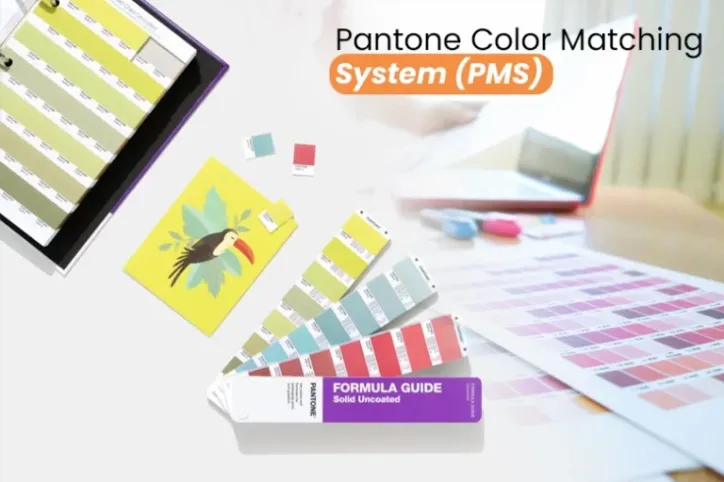
To help you choose, Pantone Corporation offers guides —basically long cards that display color swatches, color codes, the type of paper or medium the swatch is printed on, and the amounts of each color to mix.
The Benefits of Choosing Pantone Colors
When it comes to custom packaging, PMS offers tremendous benefits for businesses across different industries. From designing to printing, you know that the importance of captivating color schemes is undeniable.
Let’s have a look at the benefits of using the PMS (Pantone Matching System) and why your business needs to choose it.
Ensures Color Consistency
The main benefit of choosing PMS printing is its ability to provide a standardized color language. With Pantone, what you see in the guidelines is what you will get in print. No more guessing if your logo red will look “off” on rigid boxes, a kraft tray, or a packaging sleeve.
Strengthens Brand Recognition
Applying consistent colors across all your packaging materials builds a strong, recognizable brand identity.
Offers a Wider Color Range
PMS includes a wide library of colors, including specialty inks like metallics and fluorescents, that are not possible with other color models.
Increases print accuracy and quality
PMS colors are pre-mixed inks that produce vibrant, crisp, and accurate hues with uniform intensity. Ultimately, all the features lead to higher-quality prints.
Reduces Errors and Costs
The system eliminates the need for printers to manually match colors. Instead, PMS provides a precise reference for all printing projects. As a result, this color model reduces the risk of costly printing errors and reprints due to color mismatches.
Handles Material Variations
The system accounts for different material stocks and finishes. With its specific codes, PMS shows how a color will appear on various printed materials.
Pantone vs CMYK: Know the Difference
Now, speaking of custom packaging boxes, two popular color models are known to be Pantone and CMYK. When you work with an experienced packaging supplier, such as Custom Box Makers, you may be offered to choose between the two. To avoid any confusion, let’s know the difference between them.
Characteristics
PMS colors are pre-mixed inks, and hence, they create a consistent appearance across all platforms, which is essential for maintaining brand identity.
Meanwhile, the CMYK (Cyan, Magenta, Yellow, and Black) inks are combined in varying degrees to produce a wide range of colors. The technique uses physical pigments, which means the more ink added, the darker the color becomes.
Applications
Various businesses use PMS colors for their brand logos, packaging designs, and other branded materials that require precise color matching. Since the technique offers more consistency, it’s ideal for presenting branding elements across multiple formats, from your business cards to billboards.
CMYK, on the other hand, is the standard model for anything print-related, from brochures to business cards. Its four-color process can create rich, full-color images and graphics, offering flexibility for different printed materials.
Use Cases
Consider PMS if you think that brand consistency is non-negotiable. Some global brands, such as Coca-Cola and Tiffany & Co., use Pantone colors to convey their brand image through custom packaging, marketing materials, and merchandise.
If accurate color representation is essential to your business, you should choose CMYK for printed materials such as magazines, posters, or product packaging.
Printing Techniques
PMS is suitable for offset printing technique as it uses pre-mixed, specific inks for exact color matching. Meanwhile, a combination of CMYK inks and digital printing technique is the ideal pair.
For a quick comparison, have a look at the table below.
| Features | PMS | CMYK |
| Characteristics | Pre-mixed inks to create a consistent appearance across all platforms | Cyan, Magenta, Yellow, and Black inks are combined to produce a wide range of colors. |
| Applications | Brand logos, packaging designs, and other branded materials | Anything print-related, from brochures to business cards |
| Use Cases | Custom packaging, marketing materials, and merchandise | Magazines, posters, or product packaging |
| Printing Technique | Offset printing | Digital printing |
For a deeper comparison, you can also read our full guide on PMS vs CMYK to understand how both printing methods work for custom packaging.
Final Thoughts
No doubt, Pantone Color Matching System, or PMS, has become a preferred choice for many brands, and it has remained the industry standard. When it comes to custom packaging, PMS offers tremendous benefits, such as ensuring color consistency, strengthening brand recognition, offering a wider color range, increasing print accuracy and quality, reducing errors and costs, and handling material variations.
Nevertheless, Pantone Color Matching System sets a high standard for maintaining color consistency, regardless of the material you’re printing on.
FAQs
What Is the Pantone Matching System?
Pantone Matching System color is a standardized color reproduction technique using more than 1,000 standardized, pre-mixed “spot” inks.
What are the different PMS Color Palettes?
PMS includes different color palettes, including solid Pantone palette, process palette, textile palette, plastic palette, and goe palette.
What are the benefits of choosing PMS color model?
PMS offers tremendous benefits, such as ensuring color consistency, strengthening brand recognition, offering a wider color range, increasing print accuracy and quality, reducing errors and costs, and handling material variations.
What printing technique suits PMS colors?
PMS is suitable for offset printing technique as it uses pre-mixed, specific inks for exact color matching.

