

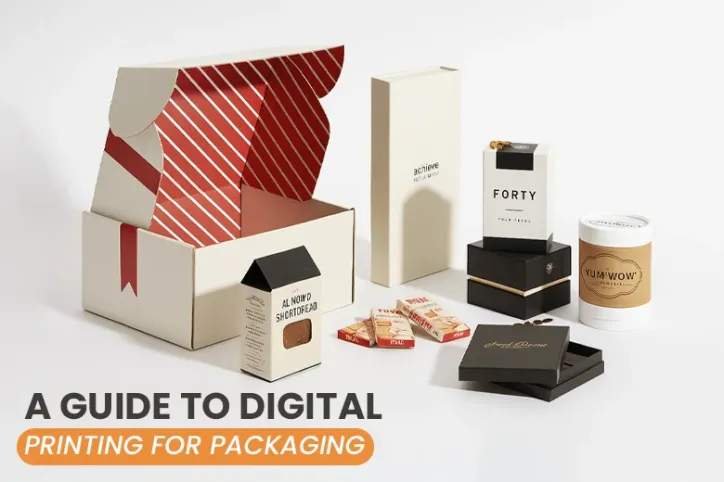

Your product packaging is the first chance to make a positive impression on your customer’s mind. Whether you are selling your product on a physical shelf or in an online store, it’s the packaging that adds to the customer experience. It’s the packaging that customers notice at first. If your packaging is made and printed with the right applications, it’s guaranteed that your product will surely gain attention. This is where digital printing comes in. It is a technique where the digital file of your artwork is transferred to the printing materials.
At some point, you have likely interacted with digital printers, which can be found on your office desk, in high schools, or even at home for printing documents. A digital printer is not limited to printing packaging; its use is vast.
This guide will walk you through what digital printing is, how it works for packaging, and why it might be exactly what your product needs.
What is Digital Printing in Packaging?
Digital printing in packaging refers to the process that uses digital printers to transfer artwork files directly to printing materials. The digital artwork file can be in the following formats: JPEG, PNG, PDF, and AI files.
These files are converted from RGB to the CMYK color system to ensure a more accurate color output for your packaging materials when printing. Unlike other printing techniques, these printers use toner and liquid inks that are applied to the material. After that, UV curing or laser heating helps adhere the ink to the product packaging, resulting in a crisp and high-quality finish.
Digital Printing Vs. Offset Printing
Digital printing is a lot different than other traditional printing techniques, such as offset printing. Digital printing eliminates the need for plate setups before printing, making it a time-effective process. Instead of using plates, the digital image is transferred directly to the printing material.

It’s also more cost-effective than other traditional printing methods. Check out the table below to see how both options compare:
| Digital Printing | Offset Printing | |
| Cost | Low costs, as no plate setup is needed. | High initial setup cost. Economical for large printing runs. |
| TAT | Fast Production. | Requires more setup time. |
| Customization | Fully customizable. | Customizable to some extent. |
| Print Quality | High Quality with color precision. | Consistent & superior quality. |
If you want to learn more about traditional printing techniques, you can read our blog on the offset printing guide.
How Effective is Digital Printing in Packaging?
Digital printing is highly effective, particularly for brands seeking the fastest turnaround times for their custom boxes. The boxes are created with stunning visuals and contain original designs from the artwork files. Digital printing will enable you to render the full artwork in the CMYK spectrum, which can be printed on a range of paper materials. However, it is ideal for various types of custom packaging boxes, such as folding cartons, 123 bottom boxes, display boxes, and more.
However, for complex and textured packaging, such as corrugated mailer boxes and rigid boxes, the traditional offset printing method is more effective.
What is Flatbed Digital Printing
Flatbed digital printing typically utilizes inkjet technology to print digital images directly onto the surface. Inkjet is often regarded as the future of digital printing due to its flexibility and advanced capabilities. It uses UV-curable inks, which means the ink dries instantly under UV light and adheres well to various flat surfaces. Whether it’s wood, metal, glass, or tiles, this process can handle it. Additionally, it works on materials with varying thickness levels, making it a highly versatile option for both printing and packaging.
Why Use Digital Printing
Digital printing is the most commonly used method in the packaging industry for saving cost and time. Using digital printers requires minimal effort, making them ideal for smaller order runs. Furthermore, it excels particularly in minimalist packaging designs, offering high-quality output.
This is why you should use digital printing for your next custom boxes project:
Short Runs & Sampling
Digital printing is a solid choice when you need small quantities. If you’re ordering less than a hundred pieces, digital printing will save you time and money compared to offset printing.
It also shines when you’re making custom packaging samples. Whether you’re testing new designs or showing mockups to clients, digital printing outperforms flexo and other traditional methods.
Due to the lower cost and fast turnaround, you can easily get samples printed, make any necessary changes, and then transition to offset printing for your final production run. That way, you’re not burning budget on a prototype that might still need tweaks.
Limitations
Now, digital printing isn’t perfect. One of the trade-offs is slightly lower image quality, particularly when compared to offset printing. It doesn’t support the PMS color system, so it’s not the best choice when you require precise color matching.
Digital does its best work on folding cartons. If you’re working with those, and you don’t need a ton of color matching or crazy textures, you’ll still get clean, sharp designs.
Benefits of Digital Printing
When it comes to digital printing, it offers various benefits, and some of them are as mentioned below:
- High print quality: Digital flatbed printing gives sharp details, great accuracy, and repeatable results.
- Eco-friendly: Produces less waste, reduces air pollution, and leaves a smaller carbon footprint.
- Flexible & affordable: Great for custom packaging with lower costs, making design changes easy and budget-friendly.
- Fast turnaround: No plate changes needed, which speeds up production compared to traditional methods.
Final Thoughts
Digital printing is most commonly used around the world, but not discussed in correlation to packaging. However, it is the most effective printing method for small-run packaging projects, especially when you have to meet tight deadlines.
Are you still confused about which one to choose for your packaging project? No worries, you can contact our experts to get guidance on which printing technique would be perfect for your custom packaging boxes.
