


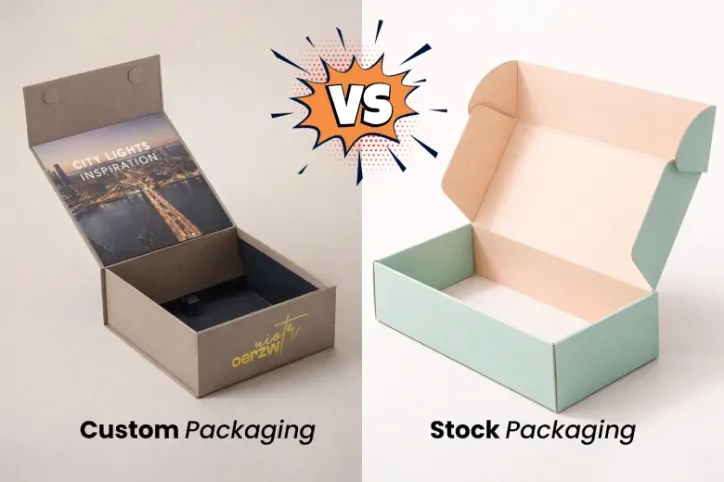

If you need packaging quickly and want to keep your initial packaging commitment low, stock packaging can be a practical option. If your product requires a specific fit, stronger branding, or a packaging structure designed around its requirements, custom packaging may make more sense.
The right choice depends on your product, order volume, budget, launch timeline, branding requirements, shipping method, and how often your packaging needs to change. The important comparison is not simply which option costs less per box, but which option works better for your total packaging requirements.
What Is Stock Packaging?
Stock packaging refers to pre-manufactured packaging that is available in standardized sizes, structures, and material options. Businesses can select an existing format and purchase it without developing a new box structure.
Stock packaging can include standard corrugated boxes, mailers, folding cartons, kraft boxes, and other ready-made packaging formats. Depending on the supplier, it may be plain or available with limited branding options such as labels or stickers.
How Stock Packaging Works
Stock packaging is produced in advance based on common packaging sizes and applications. Businesses select an available size and format, then use the packaging as supplied or add their own branding.
For example:
- A small e-commerce seller may use a standard mailer.
- A bakery may use a standard kraft food box.
- A wholesaler may ship products in generic cartons.
- A startup may use standard packaging with custom labels and stickers while testing a new product.
Advantages of Stock Packaging
Stock packaging can reduce the time and initial setup associated with developing a custom package. Since the structure already exists, businesses can generally select an available size and begin using it without creating a new dieline or completing a custom structural design process.
Stock packaging can be practical when:
- You are testing a new product or market.
- You need packaging quickly.
- Your product fits adequately into an existing size.
- Your order volume is small or unpredictable.
- You want to minimize your initial packaging commitment.
- Your packaging requirements are likely to change soon.
Limitations of Stock Packaging
The main limitation of stock packaging is that you have to work within the sizes and structures already available. If the standard dimensions do not closely match your product, you may need additional void fill or accept unused space inside the package.
Excess space can increase material usage and may affect shipping efficiency when carriers calculate charges using dimensional weight. It can also allow the product to move unnecessarily during handling.
Standard packaging also provides less structural and branding flexibility than a package developed specifically for your product.
What Is Custom Packaging?
Custom packaging is designed and manufactured according to a product’s dimensions, packaging requirements, and brand specifications.
With custom packaging, you can determine the box’s dimensions, structure, material, board thickness, printing, finishing, inserts, closures, and other functional features instead of selecting only from existing stock sizes.
Common examples include:
- Branded mailer boxes for e-commerce products
- Retail display boxes for store shelves
- Custom printed food boxes for food products
- Luxury rigid boxes for premium and gift products
The main difference is that stock packaging requires the product to fit an existing package, while custom packaging allows the package to be developed around the product.
How Is Custom Packaging Made?
A custom packaging project normally starts with the product rather than the artwork.
First, the product dimensions and packaging requirements are established. The appropriate box structure and material can then be selected based on the product’s size, weight, protection requirements, shipping method, and intended presentation.
A typical process includes:
- Measure the product: Determine the product dimensions and account for any required clearance, inserts, or internal components. Our product dimensions guide can help with this step.
- Select the packaging structure: Choose the box style or packaging format that suits the product and how it will be sold or shipped.
- Choose the material: Select corrugated, cardboard, kraft, rigid board, or another suitable material and thickness.
- Prepare the artwork: Add your logo, colors, product information, graphics, QR codes, and other approved artwork.
- Select printing and finishes: Choose the appropriate printing process and finishes such as foil stamping, embossing, debossing, matte, gloss, or soft touch.
- Add functional features: Depending on the product, you can include custom inserts, packaging insert cards, windows, dividers, closures, ribbons, or other structural features.
Not every product needs a custom box. Some products may be better suited to flexible packaging such as custom Mylar bags, depending on their size, material requirements, and intended use.
Practical Benefits of Custom Packaging
Custom packaging boxes can provide practical advantages when a standard package does not adequately meet your product or branding requirements.
A product-specific package can:
- Reduce unnecessary empty space.
- Improve product positioning inside the box.
- Reduce reliance on excessive void fill.
- Provide dedicated areas for branding and product information.
- Support specific retail or shipping requirements.
- Create a consistent packaging structure for repeat orders.
- Combine protection and presentation in one package.
A properly engineered package can also help shipping efficiency when its dimensions are closer to the actual product requirements. However, custom packaging is not automatically more efficient; the design, material, product dimensions, and shipping method all affect the result.
The Cost Reality of Stock vs. Custom Packaging
When comparing stock and custom packaging, the price of the box is only one part of the total cost.
Stock packaging may have a lower initial purchase price, but the overall packaging cost can also include labels, additional void fill, packing labor, storage, shipping dimensions, and potential product damage.
Custom packaging may involve design, sampling, setup, or production costs, but a properly designed package can reduce unnecessary material, improve product fit, and eliminate some additional packaging steps.
Your total packaging cost can therefore include:
Total Packaging Cost = Box Cost + Setup Cost + Branding Materials + Void Fill + Labor + Storage + Shipping + Damage/Replacement Costs
For a more detailed breakdown, see our guide on how much custom packaging costs.
The right comparison is the total cost of getting your product packaged, stored, shipped, and delivered—not simply the price printed on a box quotation.
Stock vs. Custom Packaging and Sustainability
Neither stock nor custom packaging is automatically the more sustainable option.
Stock packaging can be a sensible choice when an existing size already provides a suitable fit, because there is no need to create a new structural package.
Custom packaging can reduce unnecessary material and void fill when the package is engineered closely around the product. However, additional coatings, finishes, inserts, or oversized custom structures can also increase material use.
When sustainability is important, consider the material, package size, amount of empty space, shipping requirements, recyclability, and how the packaging will be disposed of after use.
Stock vs. Custom Packaging: Side-by-Side Comparison
| Factor | Stock Packaging | Custom Packaging |
|---|---|---|
| Cost | Usually lower initial cost | May require higher initial investment |
| Availability | Existing sizes can often be purchased quickly | Requires design and production |
| MOQ | Often available in small quantities | Depends on supplier, structure, material, and order requirements |
| Lead Time | Generally shorter when in stock | Requires design, approval, and manufacturing time |
| Customization | Limited to available options | Size, structure, printing, material, and finishes can be customized |
| Product Fit | Limited to standard dimensions | Designed around the product requirements |
| Protection | Depends on how well the product fits | Structure can be engineered for the product |
| Branding | Usually requires labels or other separate elements | Branding can be incorporated directly into the packaging |
| Shipping Efficiency | Standard sizes may leave unused space | Right-sized packaging can reduce unnecessary space |
| Storage | Can be purchased as needed when available | Larger production runs may require inventory planning |
| Product Changes | Easier to change sizes or formats | Existing custom packaging may need revision if the product changes |
| Repeat Orders | Depends on stock availability | The same specifications can be reproduced for repeat production |
When Should You Choose Stock or Custom Packaging?
Stock and custom packaging solve different problems. Instead of asking which option is universally better, consider what your business needs from its packaging right now.
Choose Stock Packaging When:
- You need packaging quickly.
- You are testing a new product or entering a new market.
- Your order volume is small or difficult to predict.
- An existing size provides a suitable fit.
- Your main priority is keeping the initial packaging cost low.
- Your product, branding, or packaging requirements may change soon.
- You do not need extensive printed branding.
Choose Custom Packaging When:
- Your product requires a specific size or structure.
- A standard package leaves excessive empty space.
- Your product needs dedicated inserts or internal support.
- You have consistent packaging requirements across repeat orders.
- You want branding printed directly on the packaging.
- Your product is fragile, premium, retail-focused, or uniquely shaped.
- You want to combine product protection and brand presentation in one package.
- Shipping efficiency is important, and the standard sizes are creating unnecessary space.
Consider a Hybrid Packaging Approach When:
- You need standard outer shipping packaging but want a branded customer-facing experience.
- You are testing demand but still want some brand presence.
- Different products in your catalog require different packaging approaches.
- You want to introduce custom packaging gradually.
- You want the flexibility of stock packaging while adding selected custom elements.
Packaging Choice by Business Stage
Your packaging decision can also change as your product moves through different stages of growth.
Product Testing: Stock packaging can provide flexibility while demand is still uncertain and product dimensions or branding may change.
Early Growth: A hybrid approach can combine standard packaging with custom labels, inserts, tissue, or other customer-facing branding elements.
Established Product: Custom packaging becomes more practical when product dimensions, branding, and order requirements are consistent.
Scaling Production: A dedicated custom packaging structure can provide repeatable specifications and consistent branding across larger or recurring orders.
This does not mean every business needs to move from stock to custom packaging at a specific sales volume. The right point depends on product stability, order frequency, packaging costs, storage capacity, and customer requirements.
A Practical Middle Approach
Many businesses do not have to choose between completely generic stock packaging and fully custom packaging. A hybrid approach can combine standard packaging with selected branded elements.
How It Works
- Shipping: Use a standard outer shipper when it provides sufficient protection and is readily available.
- Customer-facing presentation: Add a custom mailer, branded custom tissue paper, insert card, label, sticker, or another packaging element where branding matters.
- Targeted branding: Customize specific customer-facing components instead of redesigning every packaging layer.
- Scalable flexibility: Start with standard packaging while demand is uncertain, then introduce custom packaging as product requirements and order patterns become more consistent.
This approach can be useful for businesses that want to control their initial packaging commitment without giving up all branding opportunities.
What Should You Consider Before Choosing Packaging?
Before placing an order, compare the factors that affect your actual packaging operation:
- Speed: Do you need packaging immediately, or can you allow time for design and production?
- Product fit: Does a standard size protect your product adequately?
- Order volume: Are you testing demand, ordering occasionally, or purchasing packaging repeatedly?
- Branding: Is plain packaging acceptable, or do you need printed packaging?
- Shipping: Could unused space increase void fill or dimensional shipping costs?
- Storage: Do you have enough space for packaging inventory?
- Product changes: Are your product dimensions or branding likely to change soon?
- Customer experience: Does packaging play an important role in retail presentation or unboxing?
- Protection: Does your product need inserts, dividers, cushioning, or a specific structural design?
- Total cost: Are you comparing the complete packaging cost rather than only the box price?
Looking at these factors together will give you a more useful answer than comparing stock and custom packaging based on unit price alone.
Final Considerations
Choosing between stock and custom packaging depends on your product requirements, order volume, budget, timeline, branding needs, and shipping method.
Stock packaging is often practical when you need a readily available standard size, lower initial commitment, or flexibility while testing a product.
Custom packaging becomes more useful when product fit, structural requirements, direct branding, protection, retail presentation, or repeatable packaging specifications are important.
If you are not ready for fully custom packaging, you can start with standard packaging and add custom elements such as inserts, labels, sleeves, tissue, or packaging cards as your business develops.
Not sure which option fits your product? Share your product dimensions, quantity, shipping requirements, and branding goals with our team. We can help you compare the available packaging approaches based on your specific requirements.
FAQs
What is the difference between stock and custom packaging?
Stock packaging is pre-manufactured in standard sizes and structures, while custom packaging is designed according to specific product dimensions, branding, materials, and functional requirements.
Is custom packaging more expensive than stock packaging?
Custom packaging can have higher upfront costs because it may involve design, sampling, setup, or production requirements. However, the overall cost depends on order volume, product fit, shipping, labor, void fill, and other packaging expenses.
When should a startup use stock packaging?
Stock packaging can be practical for startups testing a product, working with uncertain demand, needing packaging quickly, or trying to minimize their initial packaging commitment.
When should a business consider custom packaging?
A business should consider custom packaging when it needs a specific product fit, stronger branding, additional protection, custom inserts, retail presentation, or a repeatable packaging structure.
Is custom packaging better for ecommerce?
Custom packaging can be useful for ecommerce when product fit, shipping efficiency, protection, or branded unboxing are important. Stock packaging may be more practical when speed, flexibility, or low initial commitment is the priority.
Can I combine stock and custom packaging?
Yes. Businesses can use standard packaging with custom labels, stickers, tissue paper, inserts, sleeves, or packaging cards. This hybrid approach provides some branding without requiring every packaging component to be custom manufactured.
Can custom packaging reduce shipping costs?
It can, when the custom package is properly right-sized and reduces unnecessary empty space. Shipping costs also depend on the carrier, package dimensions, actual weight, shipping destination, and service.
Is custom packaging more sustainable than stock packaging?
Not automatically. Sustainability depends on material selection, package size, empty space, coatings, inserts, shipping requirements, and end-of-life considerations. A well-sized custom package can reduce unnecessary material and void fill, while a suitable stock package may already provide an efficient fit.
What information do I need before ordering custom packaging?
You should have the product dimensions, quantity, preferred packaging style, material requirements, branding or artwork, shipping requirements, and any inserts or functional features you need.


