


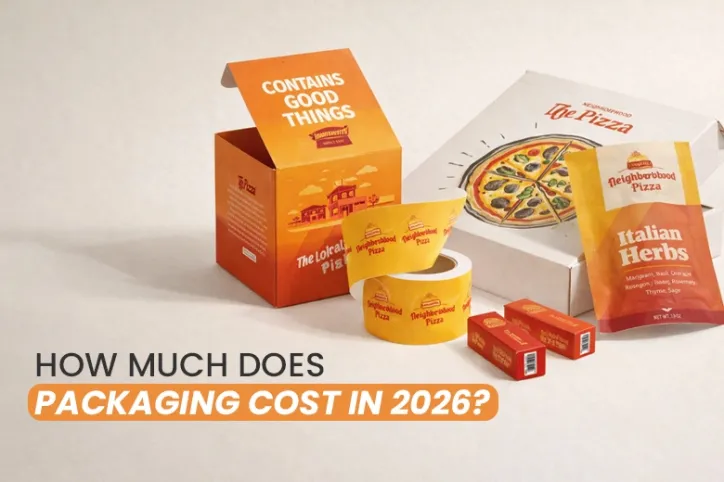

When you request a quote, negotiate with packaging suppliers, or calculate margins, the real question is not simply how much your custom packaging will cost you but how this pricing will work.
Some other queries that will pop into your head include how much you should invest per product and how to ensure the packaging supports profitability rather than reducing it.
In 2026 and years to come, the average packaging cost depends on raw material pricing, manufacturing complexity, labor, freight rates, sustainability requirements, and order quantity.
The same box can cost $0.50 to $8, depending on your decisions. And this rough figure applies to a range of custom packaging solutions, from sturdy boxes to flexible bags.
Understanding those decisions is what separates a strategic investment from an unnecessary load and expense.
Average Packaging Price by Box Type (2026)

It is beneficial for a consumer to do their research about what packaging is and how many types of packaging are available in the market for a product.
After that, it will be easier to understand how the price range fluctuates or how you can control it. Below, we have mentioned a realistic and standardized per-unit pricing overview. These numbers reflect mid-level customizations and commercial quantities.
| Box Type | Estimated Price Range (Per Unit) |
| Folding Cartons | $0.40–$2.50 |
| Corrugated Mailer Boxes | $0.50–$5.00 |
| Custom Rigid Boxes | $1.00–$20.00+ |
| Cardboard Product Boxes | $0.70–$6.00 |
Prices vary depending on box dimensions, material grade, print coverage, finishing, and order volume. Lower quantities typically fall toward the higher end of each range, while large-scale production reduces per-unit cost.
What Makes Up Packaging Costs?
When packaging manufacturers prepare a quotation, they consider multiple factors that they calculate together to find the total cost per unit. Key considerations include
Material Cost
Materials are usually the largest portion of packaging costs, often carrying 45–60% of total spend. These packaging materials include paperboard, corrugated sheets, rigid board, and wrapping papers. Some practical examples are
- Standard rigid boxes: $4.00–$9.00 per unit.
- Luxury boxes, such as boxes with magnetic closures or two-piece boxes: $12.00–$25.00+ per unit.
- Plain paperboard: $0.15–$0.50 per unit.
- Custom printed retail boxes: $0.60–$1.75 per unit.
- Cartons with premium finishes (foil/embossing): $2.00–$3.50 per unit.
- Standard shipping boxes: $0.80–$2.50 per unit.
- Custom mailer boxes: $1.50–$4.50 per unit.
- Heavy-duty: $3.00–$6.00 per unit.Manufacturing & Conversion
This includes die-cutting, printing, lamination, folding, gluing, window patching, and assembly. Custom Rigid boxes cost more because they often require manual assembly.
Folding cartons are more automated, which reduces labor cost per unit. The die cuts also vary according to the design complexities.
For instance, a typical box costs $0.10 to $0.50, while custom bags cost $0.05 to $0.25 per unit, depending on how complicated they get.
Printing & Finishing
How you are going to print your packaging design directly affects the price and the premium finishes after it. To break this down more clearly, you can take help from the table below.
| Printing techniques | Price range |
| Digital printing | $0.50–$5 per unit |
| Flexographic printing | $110–$2000 per plate |
| Screen printing | $1–$20 |
| Foil printing | $17–$482 |
| Rotogravure printing | $300–$450 |
Finishing can increase unit price by $0.10 to $1.50 or more, depending on coverage and detail.
Tooling & Setup (Fixed Costs)
Fixed costs are the expenses that do not change because they are like the preparation of the machines and tools before production begins.
This preparation cost stays the same whether you produce a small batch or a large order. These include cutting dies, printing plates, and machine setup time. For example, if tooling costs $800
- At 1,000 units, that equals $0.80 per unit.
- At 10,000 units, it drops to $0.08 per unit.
This is the reason order quantity massively affects packaging costs.
Freight & Logistics
Shipping flat boxes, such as folding cartons, costs less than shipping pre-assembled rigid boxes. It is because the more space a box occupies, the higher the price it will charge.
Bigger boxes cost more to ship and take up more storage space. In 2026, changing shipping rates also affect the final total cost.
Important Pricing Terms Every Buyer Should Understand
If you are new to this field, it is crucial to understand certain terms so that you will be aware of any fraudulent and extra charges. This also helps you to interpret the supplier’s quotation correctly and make smarter ordering decisions.
Fixed Costs
Fixed costs are expenses that do not change regardless of how many boxes you produce. These are one-time or setup-related charges required to start production. In packaging, fixed costs typically include:
- Cutting die creation
- Printing plate setup
- Machine calibration and setup time
- Sampling and prototyping
For example, if the creation costs $1,000, that cost remains $1,000 whether you order 500 boxes or 50,000 boxes. The difference is how that cost is distributed. If you order:
- 500 units > $2.00 per unit from tooling alone
- 10,000 units > $0.10 per unit from tooling
This is why small production runs often appear expensive. The fixed cost burden per unit is much higher.
Variable Costs
Variable costs are those that can change as you add or subtract packaging requirements. These include:
- Raw materials (board, paper, ink, coatings)
- Per-unit labor
- Assembly time
- Packaging inserts
- Individual finishing processes
If the material cost is $0.80 per box and labor adds $0.40, every additional box increases the total cost by $1.20.
Unlike fixed costs, variable costs do not shrink dramatically with volume, but they may improve slightly through bulk purchasing of materials.
Economies of Scale
Economies of scale are a simple principle that works when the average cost per unit decreases as soon as you increase the production volume increases. It means that the more you order, the lower the price will be for bulk quantities. This happens for two main reasons.
- Fixed costs are spread across more units.
- Suppliers purchase raw materials in bulk and operate machinery more efficiently at higher volumes.
For example if
- 1,000 boxes might cost $3.50 each.
- 10,000 boxes might drop to $1.80 each.
However, economies of scale also stop and are not infinite. It means cost reduction slows as volume increases.
Diminishing Returns
Diminishing returns mean that after a certain point, ordering more boxes does not lower the price much anymore. You may double your order, but the price per box only drops a little.
For example:
- Increasing from 1,000 to 5,000 units may reduce cost by 30%.
- Increasing from 50,000 to 60,000 units may reduce cost by only 2–3%.
At higher volumes, production efficiency has already been optimized, and material pricing has already reached bulk discount thresholds. Additional quantity no longer produces meaningful savings. Understanding this prevents over-ordering simply to chase marginal price reductions.
When you order a very large quantity, the production efficiency is already optimized, and the material price is discounted as much as possible. Ordering even more will not reduce the price much. Knowing this helps you avoid buying too many boxes just to save a few cents per unit.
MOQ (Minimum Order Quantity)
MOQ, or minimum order quantity, is the smallest production run a supplier can manufacture. It means you must order at least that number of boxes for the supplier to accept your order.
Suppliers set an MOQ because starting production takes time, labor, and setup costs. If the order is too small, it is not profitable for them to produce it. Lower MOQs generally result in higher per-unit pricing because fixed costs are distributed across fewer units.
Cost Per Unit
Cost per unit is calculated by dividing the total production cost by the total quantity produced.
Formula:
Total Cost ÷ Total Units = Cost Per Unit
If the total production cost is $8,000 for 4,000 boxes:
Cost per unit = $2.00
This number is critical because it directly impacts
- Product margin
- Retail pricing
- Break-even calculations
Buyers should always evaluate the cost per unit in relation to the product’s selling price.
How Much Does Packaging Cost for a Small Business?
Small businesses usually pay more per box because they order smaller quantities. Since they make small purchases, the setup costs and material discounts are fairly distributed over fewer boxes they have ordered, making each box more expensive. In 2026, some realistic costs of packaging include
- Simple corrugated mailer: $0.40–$1.20 per unit at low volume
- Printed folding carton (1,000–3,000 units): $1.00–$3.00 per unit
- Custom rigid box (500–2,000 units): $4–$12 per unit
Packaging Cost by Structure Type & Styles in 2026
Different packaging styles cost you differently because of the materials used, production methods, and labor levels. Due to this, pricing varies significantly between every type of box, from tuck top boxes to shipping boxes made of corrugated cardboard.
Rigid Box Pricing
Rigid boxes are considered premium packaging because they use thick chipboard wrapped with specialty paper, coated with luxury finishes and printed with advanced technologies. It also often requires some manual assembly, so the labor costs also add up.
- Small rigid box, such as flip top (2–4 inches): $2.50–$6.00 per unit
- Medium rigid box, such as a drawer style (5–8 inches): $4.00–$12.00 per unit
- Large or luxury rigid box with inserts: $8.00–$25.00+ per unit
Also, prices increase with:
- Magnetic closures
- Foam or EVA inserts
- Shoulder neck structures
- Foil stamping, embossing, soft-touch finishes
- Full inside printing
Rigid packaging costs more because labor time and material thickness are significantly higher than those of folding cartons.
Mylar Bag Pricing
Mylar bags or flexible pouches are commonly used for food, supplements, cosmetics, and other small retail goods or snacks. They are lightweight and cost-efficient at scale because there is no such hard or complex process required, nor is labor cost added.
- Small pouch (under 5 inches): $0.08–$0.30 per unit
- Medium resealable pouch: $0.15–$0.60 per unit
- Large stand-up pouch with zipper and barrier layers: $0.40–$1.20 per unit
Its cost increases with:
- Matte or soft-touch finish
- Spot UV or metallic effects
- Child-resistant zippers
- Multiple barrier layers for moisture or oxygen protection
- Die-cut shapes
- Window cutouts
Folding Carton Pricing
Folding cartons are lightweight paperboard boxes that ship flat and are assembled when needed. They are widely used in retail and consumer goods. Because they are fully automated and ship flat, folding cartons are one of the most cost-efficient custom packaging options.
- Basic single-color carton: $0.40–$1.20 per unit
- Full-color retail carton: $0.80–$3.50 per unit
- Premium carton with coating or specialty finish: $2.00–$5.00 per unit
Prices depend on:
- Paperboard thickness (SBS, kraft, recycled stock)
- Print coverage (outside only vs inside/outside)
- Coatings and lamination
- Die complexity
Corrugated Mailer Box Pricing
Mailer boxes are commonly used for e-commerce shipments and subscription packaging. They provide structural strength and branding space and are also used as PR boxes to send to influencers as a smart marketing move.
- Plain kraft mailer: $0.50–$1.00 per unit
- Printed exterior mailer: $1.00–$3.00 per unit
- Premium printed inside/outside mailer: $2.50–$5.00 per unit
Cost depends on:
- Flute type (E-flute, B-flute, etc.)
- Single-wall vs double-wall construction
- Full interior printing
- Box dimensions
Want to learn more about the pricing of corrugated mailer boxes? Read our detailed mailer box cost guide to better understand which factors affect pricing for mailer box packaging.
Why Custom Box Prices Vary So Much
The major differences between a $0.40 folding carton and a $12 rigid box are the materials used, the labor required, the machine time, the level of finishing, and the order quantity.
The lightweight cartons use thinner paperboard, run quickly on automated machines, and ship flat. Whereas a sturdy box uses thick chipboard and greyboard, wrapping often involves manual assembly and takes up more space during shipping.
All of these steps increase both manufacturing and transportation costs. This is why you should always make a transparent budget for your packaging needs. A low-cost product may not support expensive packaging
Because of this, packaging should match your product’s price and positioning. A low-cost product can’t have expensive packaging, as it would reduce profits.
A high-end product can use more luxurious packaging to appear more valuable and attract customers. The goal is not to choose the most expensive option, but to select a structure that supports your pricing strategy and protects your profit and product.
How Much Should You Spend on Custom Packaging?
There is no standard answer to this question; however, it requires some strategic guidelines and proper planning on how much budget you have allotted to your packaging.
For mass-market products, packaging usually stays within 8–15% of the retail price.
For premium positioning, packaging may account for 20–40% of product cost if it enhances perceived value and supports higher pricing.
Luxury brands often treat packaging as part of the product experience rather than an accessory expense. People are often attracted to the packaging more than the product.
Spending an extra $1 on packaging can let you sell the product for $5–$10 more, helping you increase your profit rather than cut it.
FAQs
How much does packaging cost for a product launch?
For small runs (1,000–5,000 units), total packaging investment may range from $2,000 to $15,000 depending on structure and customization level.
Why is custom packaging more expensive?
Custom sizing requires new tooling. Custom printing requires setup. Specialty finishes increase labor and production time. These increase both fixed and variable costs.
Is ordering more packaging always cheaper?
Ordering more boxes usually costs less per box because of bulk discounts. But buying too many can take up storage space and tie up your money, so the savings need to be worth it.
What is a healthy packaging budget?
Many brands aim to keep packaging budgets under 20% of total product cost. However, a healthy packaging budget usually falls between 10% and 40%. Luxury brands sometimes spend 5-10% of the overall budget to upgrade the unboxing experience.
How can I lower packaging costs without lowering quality?
Small structural changes can reduce cost without affecting appearance. Additionally,
- Slightly increase the order quantity to reduce the fixed cost impact
- Simplify structure or reduce unnecessary finishes
- Optimize box size to reduce material usage
- Choose flat-shipping structures when possible
- Is cheaper packaging always better?
Lower price reduces upfront cost, but poor packaging can damage products, reduce perceived value, and hurt repeat purchases. The goal is not the cheapest option quality-wise but the cost-effective option for the better brand positioning.
Why does packaging cost vary so much between suppliers?
Pricing changes based on material grade, production capacity, labor costs, and shipping terms. Some suppliers include freight in their quotes, while others list it separately. Always compare the final delivered cost, not just the factory price.
How much does packaging cost for a product?
The answer depends on product type, positioning, and order size. For crowded market products, packaging often stays between 8% and 15% of the retail price. For premium or luxury products, packaging may account for 20% to 40% of total product cost because it adds perceived value.
A $20 retail product may use $1–$3 packaging.
A $100 premium product may justify $8–$20 packaging.
How much does it cost to make a cardboard box?
The cost depends on size, thickness, printing, and quantity. In 2026, a basic Kraft cardboard box at higher volumes may cost between $0.35 and $0.60 per unit. A printed or heavier-duty box can range from $1.00 to $3.00 or more. Larger sizes and custom printing increase material and production costs.

