



Customers judge your products by how they look, and packaging influences their perceptions. As they say, “product packaging can make or break your sales.” Well, it can also shape your brand’s image.
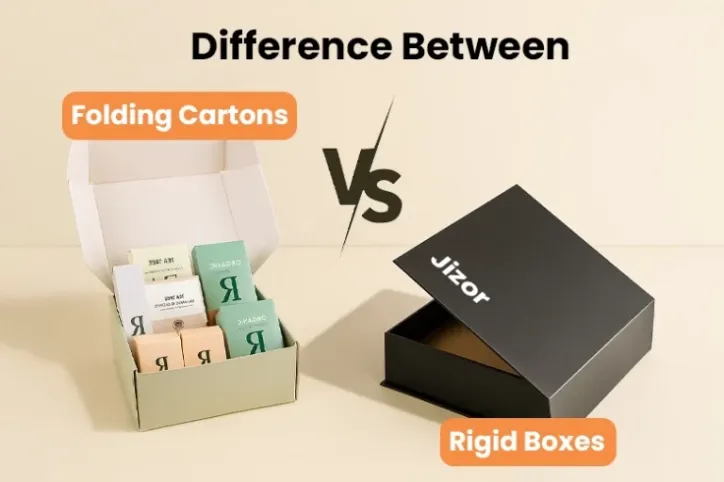
Amongst the various types of custom packaging, folding cartons and rigid boxes are the most preferred by businesses across industries. What are the differences, and how to choose between the two? Let’s reveal the features of each packaging option!
What Are Folding Cartons?

Folding cartons are lightweight boxes made of paper, and if you’re trying to understand what folding cartons are in the simplest terms, they are the affordable, customizable option for retail packaging. These cartons are produced with fewer processes and at a low cost. Additionally, they can be designed in an almost limitless range of shapes, sizes, and designs, with innovative printing options to suit various products.
You can find custom folding cartons used as retail displays for a wide range of products. The most popular example? Think about cereal boxes.
Material Options
Folding carton boxes are made using selected materials, including paperboard, SBS (solid bleached sulfate), and kraft.
Printing Capabilities
Folding cartons offer excellent printing capabilities, enabling high-quality images and vibrant graphics that enhance product visibility and brand recognition. The smooth surface of their materials allows for trendy finishing options, including matte/glossy coating, Spot UV, and hot foil stamping.
Design Essentials
Speaking of the design essentials, custom folding cartons can be shaped with advanced die-cutting techniques. Custom inserts, window cut-outs, and dividers are also available to create appealing product presentations.
Costs
Folding cartons are low-cost, making them readily available to businesses of all sizes.
Environmental Considerations
The paper-based materials make these cartons recyclable and environmentally friendly. Hence, they are ideal for sustainable brands that want to attract eco-conscious customers.
What Are Rigid Boxes?
Rigid boxes, also known as setup boxes, offer sturdy construction and are uncollapsible. If you want to understand what a rigid box is in technical terms, rigid packaging refers to a non-collapsible structure made from thick paperboard. These boxes maintain their shapes very well and are highly durable for shipping high-end products.
Custom rigid boxes are popular as luxury packaging for high-end products. They are available in a variety of styles and shapes to meet business requirements. Thanks to their premium layout and smooth texture, these boxes deliver memorable unboxing experiences.
Material Options
These premium boxes are constructed from thick paperboard, such as chipboard and greyboard.
Printing Capabilities
Setup boxes provide a solid surface for high-end finishing options to elevate products’ visual appeal. Their sleek texture serves as an exceptional canvas for intricate designs, aqueous coating, embossing/debossing, and hot foil stamping.
Design Essentials
Rigid boxes are flexible to accommodate various design elements, including magnetic closures, ribbon pulls, hinged lids, and custom inserts.
Costs
As they are designed with structural integrity and exceptional layouts, rigid boxes can be costly.
Environmental Considerations
Compared to folding cartons, custom rigid boxes are not really environmentally friendly. However, customers love to reuse the durable boxes for storage or decoration, further reducing packaging waste.
Folding Cartons vs Rigid Boxes: Which One to Choose?
Choosing between folding cartons and rigid boxes can be pretty challenging, especially if you’re new to this. Both options are ideal for presenting, protecting, and delivering a wide range of product types.
To make an informed decision, have a look at the quick table comparison below.
| Features | Folding Cartons | Rigid Boxes |
| Material Options |
|
|
| Printing Capabilities |
|
|
| Design Essentials |
|
|
| Costs | Low-cost | Costly |
| Environmental Considerations | Recyclable & environmentally friendly | Reusable |
So, is it really worth it to go with rigid boxes? Or should you just choose folding cartons? Nevertheless, when choosing between these packaging options, several factors should be considered.
- Product Type
First, understand if your product is fragile, heavy, or high-value. Rigid boxes are better for protection, while folding cartons work for lightweight items.
- Packaging Functionality
Choose folding cartons for retail display, or opt for rigid boxes to deliver memorable unboxing experiences.
- Branding Needs
For high-end branding, rigid boxes are the best option. On the other hand, for vibrant and cost-effective designs, choose folding cartons.
- Budget
Folding cartons are economical, while rigid boxes are a premium option.
- Sustainability Goals
Folding carton boxes offer recyclable and eco-friendly options. Meanwhile, rigid boxes are sturdy and reusable.
Overall, whatever product you are offering, you should focus on one thing: what kind of packaging attracts your targeted customers?
Here’s the scoop:
Customers often associate the packaging’s quality with the product’s quality. In fact, research shows that 61% of customers are likely to repurchase a product that comes in premium packaging, such as rigid boxes.
However, folding cartons shine as shelf-ready packaging (SRP) to improve efficiency, branding, and shelf impact.
In Summary
Undoubtedly, amongst the various types of custom packaging, folding cartons and rigid boxes are the most preferred by businesses across industries.
Folding cartons are lightweight boxes produced with fewer processes and at a low cost. Additionally, they can be designed in an almost limitless range of shapes, sizes, and designs, with innovative printing options to suit various products. Meanwhile, rigid boxes are popular in the luxury market and are available in a variety of styles and shapes to meet business requirements.
When choosing between these packaging options, consider your product type, packaging functionality, branding needs, budget, and sustainability goals.
Still need help to decide? Talk to the packaging experts at Custom Box Makers today!
FAQs
What are folding cartons?
Folding cartons are lightweight boxes produced with fewer processes and at a low cost. Additionally, they can be designed in an almost limitless range of shapes, sizes, and designs, with innovative printing options to suit various products.
What are rigid boxes?
Rigid boxes, also known as setup boxes, offer sturdy construction, and they are uncollapsible. These boxes maintain their shapes very well and are highly durable for shipping high-end products.
Which is more eco-friendly: folding cartons or rigid boxes?
The paper-based materials used to produce folding cartons make them more recyclable and environmentally friendly than rigid boxes. However, customers love to reuse durable rigid boxes for storage or decoration, further reducing packaging waste.
How to choose between folding cartons and rigid boxes?
When choosing between these packaging options, consider your product type, packaging functionality, branding needs, budget, and sustainability goals.

