

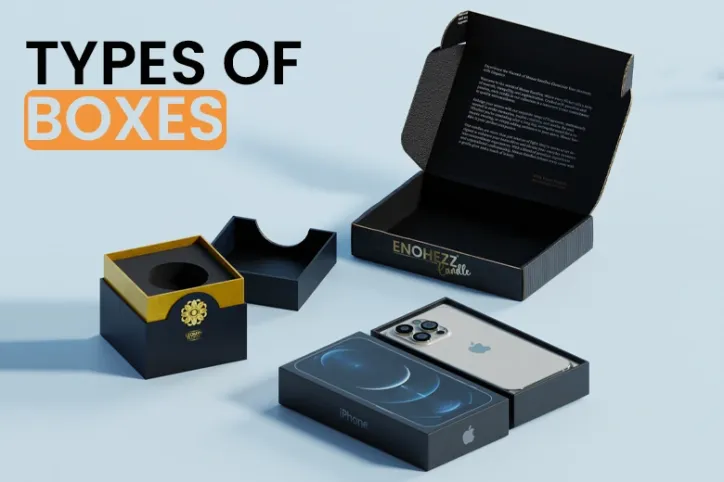

There are many different types of boxes and terms used to describe them in the packaging industry, which can confuse many people. There are many different packaging options for various purposes, such as folding cartons, rigid boxes, corrugated cardboard boxes, and paperboard boxes, among others.
However, there are three common types of boxes in the packaging industry, and all of them are made of paper pulp, with different thicknesses.
3 Common Types of Boxes
As mentioned above, there are a lot of boxes in the packaging industry, but the most common are these three:
- Folding Cartons
- Corrugated Boxes
- Rigid Boxes
Folding Cartons

Folding cartons are also known as paperboard boxes and paperboard cartons. Think of this box as a traditional cardboard box. Mostly, these boxes get used in retail businesses for various products, especially food items like cereal and toys.
Paperboard material is cost-effective, but also a bit flimsy. Meaning this can only store light-weight products. Plus, these boxes can be cut into various styles and shapes, such as tuck ends, sleeves, and more. It is a recyclable material offering an eco-friendly alternative to plastic.
Please note that paperboard comes in various thickness levels, from 14 pt. to 24 pt., for storing different products.
Here are some of the common box styles for folding cartons
1. Reverse Tuck End
Reverse tuck end boxes are made from paperboard/cardboard material that features top and bottom flaps, but in the opposite direction. They are ideal for lightweight retail items, such as cosmetics, small goods, electronics, and more.
2. Straight Tuck End
Similar to reverse tuck end boxes, straight tuck end boxes are also made from recyclable paperboard or cardboard material, which have top and bottom flaps in the same direction. These boxes are perfect for displaying high-end retail items.
3. 123 Bottom Boxes
123 bottom boxes are also known as snap-lock bottom boxes. These boxes offer a top flap and a 123 locking mechanism on the bottom of the box. This box style offers a great, solid support to your product stored inside, which makes it ideal for heavy retail items.
4. Auto Lock Bottom
It is similar to the 123 bottom box, but has an auto lock mechanism when assembling the box with the top flap. Assembling auto lock bottom boxes helps in saving time and is ideal for storing heavyweight retail items.
Corrugated Boxes

Corrugated boxes are the workhorses of the packaging world. They’re constructed from a special type of cardboard with a unique wavy layer (called fluting) sandwiched between two smooth outer layers known as liner boards. There are different flutes available that vary in the thickness of your corrugated cardboard, and those are given below:
| Flute | Millimeters | Inches |
| A Flute | 5 | 1/4 |
| B Flute | 3 | 1/8 (0.125) |
| C Flute | 4 | 11/64 |
| D Flute | 2 | (.085) |
| E Flute | 1.5 | 1/16 (0.625) |
| F Flute | 0.6 | 1/32 |
The most common flutes that are used in manufacturing corrugated boxes are either E-Flute 1/16” or B-Flute 1/8″. You can also read a blog with a complete guide on corrugated flutes and their specifications.
This design gives corrugated boxes incredible strength and durability, creating a protective cushion for the items inside.
Businesses and individuals rely on corrugated boxes for shipping, moving, and storing all sorts of things.
From fragile glassware to heavy appliances, these boxes keep their contents safe during transport, even on bumpy roads or long journeys. They’re the go-to choice when you need packaging that can withstand the rigors of handling and protect your valuables.
Here are some of the common types and box styles of corrugated boxes:
1. Mailer Boxes
They are perfect for e-commerce stores looking to deliver their products to the doorstep of their customers. Mailer boxes are made from durable corrugated material with E-flute (1/16”) and B-flute (1/8″).
2. Regular Slotted Container
A regular slotted container is also known as an RSC box. These boxes are made from sturdy cardboard corrugated boxes and come with flaps that meet in the center. It is commonly used to ship and store products.
3. Full Overlap Container (FOL)
Just like its name suggests, a full overlap container features a flap that fully overlaps the box to secure the product stored inside.
4. Pizza box
A regular pizza box is a popular type of corrugated box, which is used to deliver pizzas to consumers. Pizza boxes also feature vents that help in keeping your pizza fresh till it reaches the customer’s hand.
5. Shipping box
Another popular type of corrugated boxes is shipping boxes. Shipping boxes are made from durable corrugated material with B-flute (1/8″).
Rigid Boxes

Rigid box packaging (also known as set-up boxes) offers exceptional strength and stability. Unlike folding cartons, they won’t collapse, making them perfect for high-end products or heavy items that need extra protection. Their premium look and feel boost the perceived value of your products. Some examples of rigid boxes are given below:
- Apple’s Packaging or iPhone Box
- Gift Boxes
- Jewelry Boxes, and more.
Here are some of the common box styles of rigid boxes:
1. Magnetic Closure
A magnetic closure box features a hidden magnet in the flap hinges, helping to keep the product stored and securely in place.
2. Two Piece
Two-piece boxes consist of a lid and a base that offer a secure closure to the product stored inside. Perfect for showcasing high-end and luxurious items.
3. Collapsible
Just like its name suggests, collapsible boxes are the perfect box style if you want to showcase your high-end product. Also, these boxes can be collapsed, which helps in saving storage costs.
4. Shoulder Neck
Similar to two-piece boxes, but it comes with an internal base attached to the outer base, forming a neck when the lid is closed from above. Shoulder-neck box style offers a premium unboxing experience.
5. Book-style
A book-style box opens like a book. It has a hinged lid that keeps your product secure. It is perfect for packaging gifts, electronics, and other luxury items.
To sum it all up:
Among custom packaging manufacturers, three common types of boxes stand out: folding cartons, corrugated boxes, and rigid boxes. Each box has a feature that sets it apart from the others. Based on its construction and material thickness, each type serves specific needs, ensuring safe transportation and enhancing product presentation.


