



Before customers experience your product, they interact with its packaging. They notice the quality of printing, colors, and overall presentation. All of this can shape your brand’s image for them.
Modern packaging requirements focus more on customization, premium appearance, and flexibility. This means brands have more printing options than ever before. One such option is UV printing, a technology widely used to create detailed, high-quality packaging designs.
In this guide, you will learn how UV packaging works, which materials it can be used on, its benefits and limitations, and how it differs from other UV-related processes like spot UV and UV coating. If you want to understand any of these, read it to the end. You will have a clear idea of each one.
What is UV Printing Actually?
UV printing is mostly confused with other UV terms such as spot UV coating. That is why it is necessary to clarify what UV printing actually is.
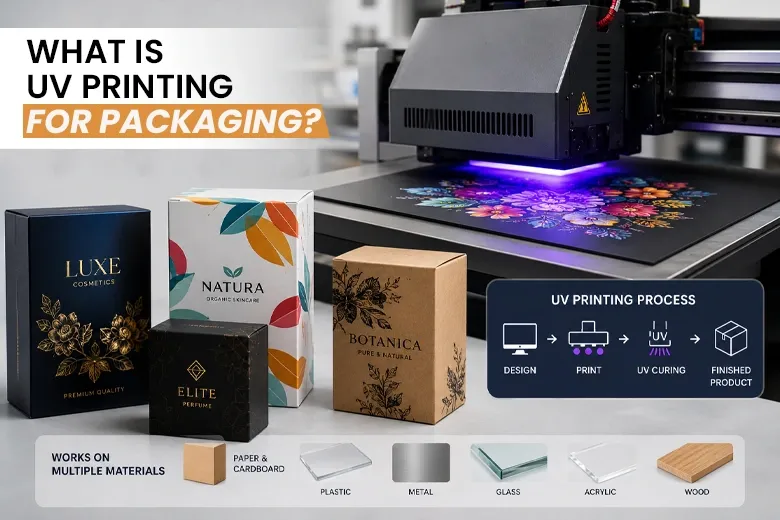
UV printing is a printing process that uses specially formulated UV-curable inks and ultraviolet light to create graphics on compatible surfaces. Unlike traditional inks that take a long time to dry through absorption or evaporation, UV inks dry and set quickly after being exposed to UV light. This curing process hardens the ink and creates a sharp, durable printed layer on the material.
For packaging, UV printing is commonly used when brands need detailed artwork, customized designs, prototypes, short production runs, or printing on special materials.
It can be used on many suitable surfaces, including paperboard, corrugated materials, plastics, acrylic, and other substrates. But the final result depends on the compatibility between the material, ink system, and production process.
How Does UV Printing Work?
The idea behind UV printing is simple: the ink is applied to the material and then cured immediately using UV light.
The process starts with preparing the artwork and selecting a suitable packaging material. Once the design and substrate are ready, UV-curable ink is printed onto the surface. UV lamps then cure the ink. This turns into a durable printing layer. Although the process sounds simple, every stage affects the final outcome.
Preparing the Artwork
A successful UV printing project starts with properly prepared artwork. Packaging designs are not created like ordinary flat images. They need to work with the actual structure of the box, which includes folds, cuts, glue areas, and panel placement. If you are preparing the file yourself, it helps to check the artwork preparation guidelines before sending it to print.
Before production, designers usually go through:
- Artwork size
- Dielines
- Image quality
- Colors
- Text placement
- Special effects requirements
If your design includes white inks, clear effects, or specialty surfaces, you need separate preparation for these elements in the artwork file.
For example, if you place a logo across a folding area, it may look correct on the screen, but it can create problems after the box is assembled. Proper artwork preparation helps you avoid these issues and make sure the final packaging matches the intended design.
Printing With UV-Curable Ink
After your artwork is approved, UV-curable ink is applied to the packaging material using a UV printing system. Depending on the printer and project requirements, different ink options may be used. It includes:
- CMYK inks for standard colors
- White ink for dark, transparent, or metallic materials
- Clear ink for specialty effects
One reason brands choose UV printing is the level of detail it can achieve. Since the ink dries instantly upon application, it remains more controlled on the surface and helps maintain sharp graphics, fine text, and detailed branding elements.
UV Curing Process
The defining feature of UV printing is its curing stage. After the ink is printed, ultraviolet light triggers a chemical reaction within it. This causes it to harden within seconds.
This quick curing process offers practical benefits for packaging production. Printed materials can usually proceed without lengthy drying periods, and the artwork remains crisp and consistent on suitable surfaces.
What Materials Can be Used for UV Printing?
One of the biggest benefits of printing is its flexibility. Unlike some traditional printing methods that are limited to specific surfaces, UV printing can work with a wide range of compatible materials.
For packaging, UV printing may be used on:
- Coated paperboard
- Corrugated materials
- Rigid packaging materials
- Plastics
- Acrylic
- Metal
- Glass
- Specialty substrates
But successful UV printing depends on more than just the material itself. The surface, ink system, and production settings all play an important role.
For example, two materials may look similar but behave differently during printing. Some surfaces may require additional perspiration, such as cleaning, testing, or primer application, to achieve proper ink adhesion.
This is particularly important for packaging because printed surfaces must perform after cutting, folding, shipping, and handling, not just look good when they come off the printer.
Where is UV Printing Used in Packaging?
UV printing is especially useful when brands need flexibility, customization, and high-quality visual results.
Packaging Prototypes and Samples
Before launching a product, many brands want to see and test their packaging design in the form of physical samples. UV printing can be a practical solution for prototypes because it allows you to check:
- Color accuracy
- Artwork placement
- Branding impact
- Shelf appearance
- Overall package design
This is particularly useful during product launches, limited editions, and packaging redesign.
Short-Run Custom Packaging
Not every brand needs thousands of identical boxes. Startups, seasonal campaigns, promotional releases, and limited product collections mostly need smaller quantities but with customized artworks.
UV printing provides the flexibility needed for such projects, especially when brands want to test the market before moving into larger production.
Premium Retail Packaging
For industries such as cosmetics, electronics, luxury goods, and specialty products, packaging plays an important role in customer perception. Retail boxes can be printed with UV technology to add:
- Detailed product graphics
- Sharp color logos
- Strong brand colors
- Premium visual appeal
For example, a cosmetic brand launching a limited-edition collection may use UV printing to achieve detailed artwork on cosmetic boxes or specialty packaging materials.
Types of UV Printing
UV printing is not a single printing method. It refers to printing technologies that use ultraviolet light to cure UV-reactive inks immediately after they are applied. Different UV printing methods are used depending on the packaging material, production volume, and design requirements.
UV Digital Printing
UV digital printing uses digital files to print artwork directly onto the packaging surface. It does not require traditional printing plates, making it suitable for prototypes, samples, short production runs, and customized packaging.
It is commonly used when brands need:
Fast artwork changes
Variable designs
White ink printing
Printing on specialty materials
Detailed graphics and small text
UV Offset Printing
UV offset printing uses printing plates to transfer ink onto packaging material and cures the ink instantly with UV light. It is commonly used for higher-volume packaging projects where consistent color reproduction and premium print quality are required.
It is suitable for:
Retail packaging
Large production quantities
UV Flexographic Printing
UV flexographic printing uses flexible printing plates and UV-curable inks. It is mainly used for continuous printing applications such as labels, films, and certain types of packaging materials.
It works well for:
High-volume production
Packaging films
Repetitive designs
For custom box packaging, UV digital and UV offset printing are the most commonly relevant methods. The best option depends on factors such as order quantity, packaging material, artwork complexity, and finishing requirements.
Benefits of UV Printing for Packaging
Though UV printing has many useful benefits, it only works best when they match the requirements of the project.
Sharp and Detailed Graphics
UV printing is particularly useful for packaging designs where precision matters. Due to the fact that the ink is cured immediately after being applied, it helps maintain clean edges, fine details, and consistent artwork reproduction on suitable materials.
For brands, this means custom boxes can showcase detailed logos, small text, illustrations, and complex designs without losing visual clarity.
Faster Production Handling
The curing process requires less time than traditional printing methods with long drying times. That is why the UV printing method has a shorter production time. This makes it best for rush orders or last-minute editions.
Ability to Print on Specialty Materials
UV printing provides more flexibility when working with unusual or premium materials. Brands exploring unique packaging concepts benefit from having more options beyond standard paper-based surfaces.
White Ink Options
White ink is another important advantage of UV printing. It allows brands to create better results on materials such as:
- Dark-colored packaging
- Transparent surfaces
- Metallic stocks
- Specialty boards
Without a white base layer, the original color of the material can affect the appearance of the printed artwork.
Limitations of UV Printing
It is hardly possible that anything only has pros. Similarly, while UV printing offers many advantages, it is not the perfect solution for every packaging project.
Material Compatibility
UV printing does not automatically work the same way on every surface. Ink adhesion depends on the material, coating, ink formulation, and production settings. Some materials may require testing or surface preparation before full production.
Cost Considerations
UV printing can be a practical choice for prototypes, customized packaging, and shorter production runs. However, for very large quantities of identical packaging, other packaging methods may sometimes offer better cost efficiency.
The best choice depends on factors such as quantity, material, artwork complexity, and finishing requirements.
Folding and Structural Requirements
Packaging is different from ordinary printing because the printed material must eventually become a physical product. A box may need to be cut, folded, glued, and handled during shipping.
Heavy ink coverage around folding areas should therefore be considered during design and production planning.
UV Printing vs Spot UV vs UV coating
These three terms are often confused for being similar, but they describe different processes.
Feature | UV Printing | Spot UV | UV Coating |
Purpose | Creates the printed design | Highlights selected areas | Adds a clear surface coating |
Material applied | UV-curable ink | Clear UV coating | Clear UV coating |
Coverage | Based on artwork | Specific areas only | Larger surface area |
Common use | Graphics, text, branding | Logos, patterns, premium accents | Gloss and protection |
UV Printing
UV printing creates the main artwork on the packaging. The colors, images, and text are produced using UV-curable inks.
Spot UV
Spot UV is a finishing process that is applied after printing. A clear glossy coating is placed only on selected areas to create contrast.
Need a clear view? Imagine a black matte box with a glossy logo that stands out when touched or viewed under light.
UV Coating
UV coating applies a clear coating over printed material. It is often used to improve appearance, add gloss, or provide additional surface protection.
Is UV Printing the Right Choice for Your Packaging?
UV printing can be a great option for your brand if you want detailed graphics, customized packaging, specialty materials, or premium visual presentation.
It is especially suitable for:
- Prototypes
- Short-run packaging
- Customized product boxes
- Premium retail packaging
- Projects requiring white ink or specialty effects
However, the right printing method depends on the complete packaging project. Material, quantity, design, finishing, and budget all influence the best solution.
UV Printing vs Conventional Printing: Which One Should You Choose?
UV printing and conventional printing methods both have their place in packaging production. The right choice depends on your packaging goals, order quantity, material, and design requirements.
| Feature | UV Printing | Conventional Printing |
|---|---|---|
| Drying process | Ink cures instantly using UV light | Ink dries through absorption or evaporation |
| Print detail | Excellent for fine details, small text, and complex graphics | High-quality results but depends on the printing method |
| Material flexibility | Can print on many coated and specialty surfaces | Usually works best with compatible paper-based materials |
| Production volume | Ideal for prototypes, customization, and short-to-medium runs | Often more cost-effective for high-volume production |
| Special effects | Supports white ink, clear ink, and specialty effects | May require additional processes for special effects |
| Setup requirements | Often requires less setup for digital UV printing | Traditional methods may require plates or additional preparation |
Choose UV Printing When:
You need detailed artwork or complex branding elements
You are producing prototypes or smaller quantities
You want to print on specialty materials
Your design requires white ink or unique visual effects
Fast production handling is important
Choose Conventional Printing When:
You need very large quantities of the same design
Cost efficiency is the main priority for bulk orders
Your packaging uses standard materials and designs
Traditional printing workflows already meet your requirements
The best printing method is not always the newest technology. It depends on your packaging requirements, including quantity, material, artwork complexity, finishing options, and budget.
Frequently Asked Questions About UV Printing
What is UV printing in packaging?
UV printing is a printing process that uses UV-curable inks and ultraviolet light to instantly cure the ink after it is applied to a packaging surface. This creates sharp, durable graphics and allows printing on various compatible materials, including coated boards, plastics, and specialty substrates.
Is UV printing the same as Spot UV?
No. UV printing and Spot UV are different processes.
UV printing creates the actual printed artwork, including colors, images, and text, by using UV-curable inks. Spot UV is a finishing technique where a clear glossy coating is applied only to selected areas, such as logos or patterns, to create contrast and a premium effect.
Is UV printing better than traditional printing?
UV printing is not always better than traditional printing. The right choice depends on the project requirements.
UV printing is often preferred for detailed artwork, specialty materials, prototypes, short runs, and designs requiring white ink or unique effects. Traditional printing methods may be more cost-effective for very large production quantities with the same design.
Can UV printing be used on cardboard boxes?
Yes, UV printing can be used on many cardboard and paperboard packaging materials, including coated paperboard and certain corrugated materials. However, the final print quality depends on the surface coating, ink compatibility, and production setup.
Is UV printing waterproof?
UV printing produces a durable ink layer that is more resistant to moisture, scratching, and fading compared with some traditional printing methods. However, the final water resistance depends on the packaging material, ink system, and whether additional protective coatings are applied.
Does UV printing work on dark-colored packaging?
Yes. One advantage of UV printing is the ability to use white ink as a base layer. This allows brands to achieve brighter colors and clearer graphics on dark, transparent, metallic, or specialty packaging materials.
Is UV printing expensive?
The cost of UV printing depends on several factors, including packaging quantity, material, artwork complexity, ink requirements, and finishing options.
UV printing can be cost-effective for prototypes, customized packaging, and short production runs. For very high-volume orders, other printing methods may sometimes provide better cost efficiency.
What is the difference between UV printing and digital printing?
UV printing and digital printing are not always separate categories. UV digital printing is a type of digital printing that uses UV-curable inks and ultraviolet light for curing.
The main difference is the ink and curing technology. Standard digital printing may use conventional inks or toners, while UV digital printing uses UV-reactive inks that cure immediately after printing.
Is UV printing suitable for luxury packaging?
Yes. UV printing is commonly used for premium packaging because it can produce detailed graphics, sharp branding elements, white ink effects, and designs on specialty materials. It is often combined with finishing techniques such as Spot UV, embossing, or coatings to create a high-end appearance.

