


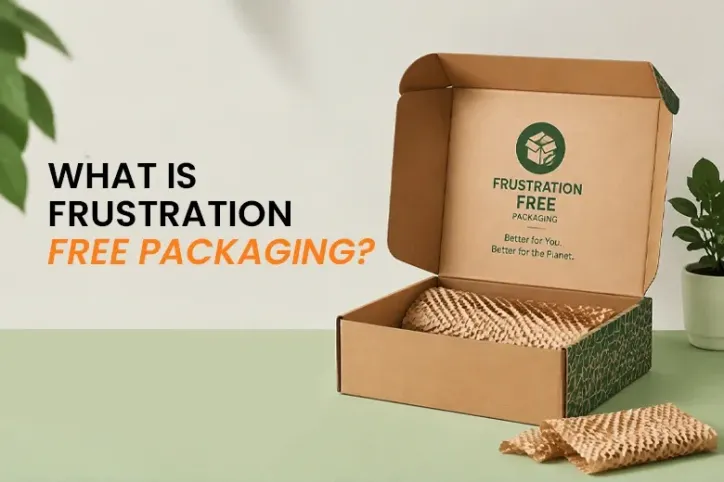

Have customers been annoyed by the packaging you offer? Does it frustrate your customers to open the package and regret purchasing? If so, you can fix it by using frustration-free packaging.
When your product is designed with FFP, it ensures a secure, seamless unboxing experience for your customers while offering multiple advantages in cost-effectiveness, safety, and sustainability.
In this comprehensive guide, we will walk you through frustration packaging and how it differs from standard packaging.
What is Frustration-Free Packaging (FFP)?
Frustration-free packaging is an Amazon concept introduced in 2008, designed to make customers’ unboxing experience as easy as possible. The main purpose of this packaging is to provide an easily openable, hassle-free, and waste-free packaging solution.
This concept was initially launched to reduce “wrap rage”. The customers got frustrated because their package was hard to open, which led them to damage their product and have a poor unboxing experience. Upon this, Amazon introduced frustration-free packaging.
Why Amazon Created Frustration Free Packaging?
Amazon’s Frustration-Free Packaging program, which is now referred to as Ships in Product Packaging (SIPP), was created to have two primary goals:
- Cost-efficient packaging by reducing material use and labor costs.
- Reducing customer frustration by creating packaging that provides a streamlined experience.
They identified these two primary goals by seeing customers’ concerns about having bad experiences with Amazon packaging. They used to package even the tiniest products in large shipping boxes, and recycling them takes time.
How Frustration-Free Packaging Works
Frustration-free packaging, or FFP, is all about making unboxing easy. Popularized by Amazon, it cuts out the annoying “wrap rage” from stubborn clamshells, wire ties, and over-the-top filler. The idea is simple: use right-sized, minimal, and fully recyclable materials that serve as both the product box and the shipping container. Further, Amazon packaging can be described in three packaging tiers.
Tier 1 — Frustration-Free Packaging (FFP)
Tier 1 is the highest standard. Products ship in right-sized, fully recyclable boxes without extra outer packaging. It removes plastic, ties, and fillers while ensuring easy opening, strong protection, and a clean, frustration-free unboxing experience.
Tier 2 — Ships in Product Packaging (SIPP)
Tier 2 uses the product’s original packaging as the shipping box. It is tested for durability and transit safety, so no extra outer carton is needed. This reduces waste, lowers material use, and keeps packaging simple.
Tier 3 — Prep-Free Packaging (PFP)
Tier 3 allows products to ship without additional prep, such as bubble wrap or poly bags. Packaging already meets basic shipping requirements, reducing warehouse handling time. It may still use an outer box, but it eliminates unnecessary preparation steps.
What Happens at the Warehouse Level
At the warehouse level, frustration-free packaging keeps operations simple and efficient. Products arrive already packed in right-sized, ready-to-ship boxes, so there is no need for extra outer cartons or excessive void fill. This reduces handling time, speeds up order fulfillment, and lowers labor costs.
It also minimizes packaging waste across the supply chain. With fewer materials to manage and faster processing, brands can move inventory quickly while maintaining consistency in how products are packed and shipped.
The Customer Unboxing Experience
The customer unboxing experience is where frustration-free packaging delivers real value. Packages are easy to open without scissors or knives, which removes the common pain points of traditional packaging. There is no excess plastic, no tangled ties, and no unnecessary layers to deal with.
Everything feels clean, simple, and intentional. The product is presented neatly, which improves perceived quality. This smooth, hassle-free unboxing builds a stronger connection with customers and leaves a lasting impression of the brand.
Frustration-Free Packaging Vs Standard Packaging
The key difference between frustration-free packaging and standard packaging lies in their design, the materials used, and the overall customer experience they deliver.
Standard packaging focuses on the aesthetic appeal, branding, and product protection. It involves multiple steps, complex unboxing, and non-recyclable materials. These factors may enhance your product’s appearance, but they often lead to a frustrating unboxing experience for customers.
However, frustration-free packaging focuses on easy access, waste reduction, and the use of recyclable materials. While it may look simple, it is far more practical and functional than standard packaging. It improves the unboxing experience by making it quick and easy to access the product, without requiring extra tools or excessive force.
Here’s a quick comparison table of Frustration-Free Packaging Vs Standard Packaging:
| Feature | Frustration-Free Packaging (FFP) | Standard Packaging |
| Design Approach | Minimal, right-sized, purpose-built | Often oversized and layered |
| Materials Used | Recyclable, eco-friendly materials | Mixed materials, often plastic-heavy |
| Ease of Opening | Easy to open without tools | Difficult, may require scissors or knives |
| Packaging Waste | Reduced waste and filler | Excessive filler and unnecessary layers |
| Shipping Efficiency | Ships in its own box or minimal outer packaging | Requires additional shipping cartons |
| Customer Experience | Smooth, simple, frustration-free | Can cause “wrap rage” and inconvenience |
| Sustainability | Designed with environmental impact in mind | Less focus on sustainability |
| Cost Efficiency | Saves on materials and shipping over time | Higher material and handling costs |
Common Types Of Frustration-Free Packaging
The Amazon’s frustration-free packaging comes in a variety of box styles, shapes, and materials. Each has its own unique characteristics and needs. This allows products to find the right fit and packaging type that aligns with your brand identity and shipping needs.
Here are the common types of frustration-free packaging:
Corrugated Cardboard Boxes
Corrugated cardboard boxes are the most common type of FFP, as they provide a cushioning effect that prevents your product from cracking, keeping the product inside fully protected.
Not only are they durable, but they are also lightweight, shipping-friendly, and cost-effective, which makes them a perfect option for frustration-free packaging.
Here are some of the key features of corrugated cardboard boxes:
- Durable and Protective: Corrugated cardboard provides strong structural support, keeping products safe during transit without needing extra fillers or packaging layers.
- Easy to Open: Designed for hassle-free unboxing, these boxes open quickly without scissors or knives, enhancing the customer experience.
- Eco-Friendly: Made from recyclable materials, corrugated boxes reduce packaging waste and support sustainable shipping practices.
However, you can get them in various box styles, including tuck-top boxes, mailer boxes, and more.
Padded Papers:
Padded shipping envelopes and mailer pouches offer a smart, efficient way to ship items like books, electronics, and cosmetics. Their compact design, combined with built-in cushioning, helps protect contents during transit, eliminating the need for excessive, wasteful packaging.
Designed for smaller and more delicate products, padded envelopes are a practical packaging solution thanks to:
- Peel-and-seal closures: Strong adhesive strips allow for quick sealing and easy opening without extra tape.
- Sustainable materials: Often made from recyclable paper or biodegradable plastics, making disposal simple and environmentally responsible.
In addition, Kraft mailers are another excellent option, offering durability, a natural, eco-friendly appearance, and reliable protection for lightweight shipments while maintaining a professional, minimalist look.
Box Inserts
Rather than using fillers or bubble wrap to protect and provide a perfect fit for your products, use custom box inserts. These inserts are made from eco-friendly materials, such as paperboard or cardboard. These inserts allow you to perfectly fit and secure your product while enhancing the unboxing experience for customers.
You can also use paper inserts that add value to your product presentation, such as tissue paper or crinkled paper.
Reusable Packaging
Reusable packaging takes Frustration-Free Packaging (FFP) to the next level. It is not just about being eco-friendly; it is about making the whole unboxing experience smoother, easier, and genuinely useful for the customer.
- Feature: Reusable, easy-to-open design.
- Function: Quick access while doubling as storage or a return option.
- Purpose: Cuts frustration, reduces waste, and gives packaging a longer life.
Take a resealable mailer with a tear-strip opening. No scissors, no tape struggles. It is sturdy enough to reuse for returns or storage, so customers are not just opening and tossing; they are getting something simple, functional, and actually worth keeping.
Benefits of Frustration-Free Packaging
When Amazon introduced its Frustration-Free Packaging (FFP) program in 2008, it used an incentive approach. Vendors and products that met the FFP standards were offered monetary rewards.
In 2019, Amazon shifted to a stricter system. Non-sortable ASINs that did not meet Tier 3 PFP certification became subject to chargebacks. Sortable ASINs that did not meet Tier 2 SIPP certification were also subject to chargebacks.
For brands, the most immediate benefit of following these standards is avoiding the $1.99 chargeback per unit shipped. Amazon does not charge for missing Tier 1 FFP certification, so what are the advantages of reaching this highest level?
Here are the benefits of having frustration-free packaging:
- Reduced Packaging Costs: Designing your product and packaging for ready-to-ship status can significantly reduce material use. This not only reduces waste but also lowers packaging costs.
- Enhanced Shopper Conversion: FFP-certified packaging carries an official label you can highlight in your customer communications. It also allows your products to appear in searches when shoppers filter for FFP items, making it easier to reach the right audience.
- Positive Customer Experience: FFP certification is meant to make unboxing simple and enjoyable. Brands that meet Tier 1 certification can offer a smoother experience, which helps build long-term loyalty. Customers who receive a hassle-free package are also more likely to leave positive reviews, which are vital for the success of an Amazon storefront.
How Sellers Can Qualify for FFP Certification
If you think this is just about “better packaging,” you’re already behind. Amazon does not care about your intent. It cares about compliance, performance, and efficiency. Either your packaging meets the standard, or it does not.
Eligibility Requirements
Your product has to survive real-world shipping, not ideal conditions.
Amazon evaluates product weight, dimensions, fragility, and how it moves through its fulfillment network. If your packaging needs extra protection like outer cartons or fillers, it already fails the core idea of frustration-free packaging.
The expectation is simple. Your product should ship in its own packaging without needing help.
ISTA 6 Testing Standard Explained
This is where most sellers get exposed.
ISTA 6 testing replicates what actually happens inside Amazon’s logistics system. Packages are dropped, compressed, and subjected to constant movement and stress.
If your packaging cannot handle that, your customer will eventually receive a damaged product. Amazon eliminates that risk before it happens.
Passing means your packaging performs under pressure. Failing means you go back and fix it.
The Amazon Packaging Support and Supplier Network (APASS)
If you do not know what you are doing, APASS exists for a reason.
It is a network of Amazon-approved experts who design packaging, run tests, and guide you through certification.
You can try to figure everything out yourself, but most sellers who do end up wasting time and money fixing avoidable mistakes.
Step-by-Step Application Process
Start by evaluating your current packaging honestly. Most sellers overestimate how good their packaging is.
Redesign it to meet FFP standards. That means right-sized, minimal, and fully functional without excess materials.
- Run ISTA 6 testing to validate performance.
- Submit your results to Amazon with proper documentation.
Then you either get certified or you do not. There is no partial success here.
Common Reasons for Rejection
Most rejections come down to ignoring the basics.
- Packaging is oversized or inefficient.
- Too much plastic or unnecessary materials are used.
- The package fails drop or compression tests.
- It is difficult to open.
- Documentation is incomplete or poorly prepared.
The biggest mistake is designing for appearance instead of performance.
FFP is not about looking premium. It is about working flawlessly through the entire supply chain and delivering a clean, frustration-free experience at the end.
Common Misconceptions About Frustration-Free Packaging
Most people misunderstand frustration-free packaging because they judge it on appearance instead of performance. It looks simple, so they assume it is weaker, limited, or only about sustainability. That thinking is exactly what holds brands back. FFP is not about stripping things down for the sake of it. It is about removing what does not serve a purpose and optimizing everything that does.
If you get this wrong, you design packaging that looks good but fails in cost, efficiency, and customer experience. Here are the misconceptions that keep showing up and why they are wrong.
FFP Means Less Protection
Wrong. This is what amateurs assume when they see minimal. Less material does not mean less protection. It means smarter protection. FFP is built to survive real shipping conditions without hiding behind layers of plastic and filler. If your product breaks without excessive packaging, the issue is your product or packaging design, not FFP.
It Only Matters for Large Products
This is just careless thinking. Size is irrelevant. Small products often suffer the most from bad packaging with oversized boxes, wasted space, and unnecessary filler, driving up costs. FFP forces precision. Your packaging either fits the product and supply chain properly, or it does not.
FFP and Eco-Friendly Are Synonymous
They are not the same thing. They overlap, but they are not interchangeable. FFP is about performance, efficiency, and user experience. Sustainability is a result, not the objective. If you treat FFP as just a green initiative, you are missing the operational advantage entirely.
Where To Buy Frustration-Free Packaging?
Looking for frustration-free packaging that meets Amazon’s standards? Custom Box Makers can help. Our experts guide you through designing custom boxes that not only protect your products during shipping but also offer an easy, enjoyable unboxing experience for your customers. From selecting the right materials to creating the perfect fit, we ensure every box is functional, sustainable, and aligned with your brand. Reach out today to get packaging that works as hard as your products.
FAQs
1. What is frustration-free packaging?
Frustration-free packaging (FFP) is a packaging design approach that focuses on easy opening, minimal materials, and reduced waste. It eliminates hard-to-open plastics, excessive fillers, and unnecessary layers to create a simple and efficient unboxing experience.
2. How is frustration-free packaging different from standard packaging?
Frustration-free packaging uses right-sized, recyclable materials and is easy to open without tools, while standard packaging often includes excessive layers, plastic materials, and requires scissors or knives to open.
3. Why did Amazon introduce frustration-free packaging?
Amazon introduced frustration-free packaging to reduce customer frustration during unboxing and lower packaging costs by minimizing materials, improving efficiency, and reducing waste.
4. What are the different types of Amazon’s frustration-free packaging?
Amazon has three main types:
- Tier 1: Frustration-Free Packaging (FFP)
- Tier 2: Ships in Product Packaging (SIPP)
- Tier 3: Prep-Free Packaging (PFP)
Each level focuses on reducing packaging complexity and improving shipping efficiency.
5. What are the benefits of frustration-free packaging?
Frustration-free packaging reduces packaging costs, improves customer satisfaction, lowers return rates due to damage, enhances sustainability, and speeds up warehouse operations.
6. Does frustration-free packaging provide enough protection?
Yes. Frustration-free packaging is designed to protect products during transit using smart, efficient materials instead of excessive layers. It must pass strict shipping tests to ensure durability.
7. What materials are used in frustration-free packaging?
Common materials include corrugated cardboard, recyclable paper mailers, padded envelopes, and eco-friendly inserts designed to protect products without unnecessary waste.
8. How does frustration-free packaging improve customer experience?
It makes unboxing quick and easy by removing hard plastics, ties, and excess packaging. Customers can open packages without tools, which reduces frustration and improves brand perception.
9. How can sellers qualify for Amazon’s frustration-free packaging certification?
Sellers must design packaging that is right-sized, durable, easy to open, and able to pass ISTA 6 testing. They must then submit their packaging for Amazon approval.
10. Is frustration-free packaging the same as eco-friendly packaging?
No. While frustration-free packaging often uses recyclable materials, its main focus is efficiency and user experience. Sustainability is a result, not the primary goal.
11. Can small products use frustration-free packaging?
Yes. In fact, small products benefit the most by avoiding oversized boxes and unnecessary filler, which reduces costs and waste.
12. Does frustration-free packaging reduce shipping costs?
Yes. By using fewer materials and right-sized packaging, it reduces dimensional weight, lowers shipping fees, and improves logistics efficiency.

