

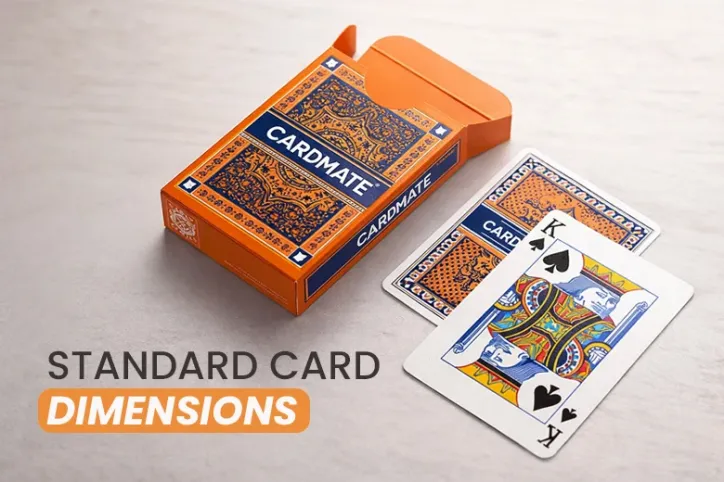

If you are searching for standard card dimensions that we commonly see in the market, you likely want a clear answer without confusion.
The most common playing card size in the world is 2.5 × 3.5 inches (63 × 88 mm). Tarot cards are typically 2.75 × 4.75 inches (70 × 120 mm).
Flashcards are often 3 × 5 or 4 × 6 inches. Credit-card-style plastic cards follow the CR80 standard at 3.375 × 2.125 inches (85.6 × 54 mm).
But these measurements alone are not enough to make a smart decision about choosing your deck size or printing on it.
Card size affects how a deck feels in the hand, how easily you can shuffle it, how much artwork fits on the surface, what packaging sleeves it requires, and how expensive its custom box will be.
Some of the formats for the cards exist for consistent gameplay efficiency, some for visual storytelling, and others for educational purposes.
To make everything clearer, we have brought this guide that explains every major card size used in games, education, divination, and identification, along with practical design and production details. Let’s get started!
Standard Sizes of Different Cards

We see multiple cards in a regular day, from credit cards in our wallets to some business cards on a counter shelf for marketing. Some of them are the same size, and others are either a bit large or maybe thicker.
Poker Cards Size
A poker card is considered the global standard for playing cards. When manufacturers refer to the term “standard playing cards,” this is the usual format they mean. It has become dominant because it offers the best balance between artwork space and hand comfort.
Its refined and exact proportions allow smooth shuffling, easy fanning, and consistent compatibility with accessories like packaging sleeves and tuck top boxes.
Mostly board game decks also follow this sizing because it simplifies packaging and reduces the complexities of production. Its dimensions are
- 2.5 (width) × 3.5 (height) inches
- 63 × 88 mm
Bridge Cards Size
Bridge cards look almost the same as poker cards but are a bit narrower. These are designed for games like contract bridge.
The height is the same as poker cards, and the width is reduced slightly. This subtle adjustment makes a noticeable difference when players hold many cards at once. This difference improves hand comfort, particularly in trick-taking games where players fan out large hands repeatedly.
- 2.25 (width) × 3.5 (height) inches
- 57 × 88 mm
European Playing Cards Size
Some European decks follow slightly taller dimensions compared to the usual American poker cards. These changes often came from the early or historic regional game traditions, like how it is supposed to be played.
The extra height slightly changes the overall visual proportions of the card, which can influence artwork layout and typography spacing.
- 2.4 (width) × 3.66 (height) inches
- 60 × 93 mm
Trading Card Game Sizes
Trading card game sizes should be strictly consistent because collectors use protective sleeves, storage binders, and display boxes that adjust to cards of the same size.
Even a 1-2 mm variation can affect its compatibility. Most collectible card games follow the poker card dimensions; however, some other exceptions are applicable.
- 2.5 (width) × 3.5 (height) inches
- 63 × 88 mm
However, Yu-Gi-Oh! cards measure 2.31 (width) x 3.37 (height) inches and 59 × 86 mm. That slight difference in size means the packaging sleeve for standard poker cards will not fit properly.
For card enthusiasts or collector-focused decks, exact millimeter accuracy matters more than it does for other or random game cards.
Tarot Cards Size
The divinity card size is intentionally larger than poker cards because they emphasize symbolism and need more space for artwork.
Their design often contains images, fine details, and decorative borders that occupy additional vertical space. Unlike other usual playing cards, tarot cards contain a 78-card deck that is further divided into two types: the major arcana and the minor arcana. The standard tarot card dimensions are
- 2.75 (width) × 4.75 (height) inches
- 70 × 120 mm
Due to its larger size, the visual clarity is more enhanced, but it also makes shuffling difficult, especially for users with smaller hands. To overcome this hurdle, there has now been an innovative invention of “pocket tarot” for convenience and carrying it anywhere easily.
Oracle and Other Divination Cards Size
Like tarot cards, oracle cards are also used for divination and do not follow a fixed global standard. Their size often depends on the artwork or the amount of message and guidance included.
Because these types of cards contain information of interpretation or affirmation text, they are wider or taller than a standard poker card. Some commonly found oracle card dimensions are
- 3 (width) × 5 (height) inches (76 × 127 mm)
- 3.5 × 5 inches (89 × 127 mm)
- 4 × 6 inches (102 × 152 mm)
Flash and Educational Card Size
Flashcards are designed primarily for learning and memory purposes. They are commonly used in classrooms, training centers, or language learning institutes.
These cards have larger formats, which allow bigger fonts, diagrams, notes, and other memorizing stuff.
- 3 (width) × 5 (height) inches = 76.2 × 127 mm
- 4 × 6 inches = 101.6 × 152.4 mm
- 5 × 7 inches = 127 × 177.8 mm
Educational cards are usually coated with lamination (a thin plastic film) for durability and their corners are also round to prevent bending and wear over time. Because the usage of educational cards is more regular and frequent than that of any other cards.
Mini Cards Size
Mini cards are exactly half the size of poker cards and are used in travel games, compact board games, or promotional giveaways.
Their smaller size lowers the material cost and packaging volume but also limits artwork space and typography size. Due to their miniature size, they work best with simple designs with icons only, rather than heavy texts and visuals.
- 1.75 (width) × 2.5 (height) inches (44 × 63 mm)
- 1.5 × 2.5 inches (38 × 63 mm)
Jumbo or Oversized Card Size
Jumbo cards are larger on purpose for visual emphasis. They are mostly used by magicians, educators, and brands that seek promotional visibility.
Its increased surface area offers enough space for your design layout and can easily be seen from a distance, but makes shuffling impractical due to obvious reasons.
- 3.5 (width) × 5 (height) inches = 88.9 × 127 mm
- 4 × 6 inches = 101.6 × 152.4 mm
- 5 × 7 inches = 127 × 177.8 mm
To package large or jumbo cards, customized sleeves are ideal, but in some cases, rigid drawer boxes or even magnetic boxes can also work.
ID Cards Size (CR80 Standard)
Identification cards use a global standard size rather than custom sizes. The CR80 format, also called ISO ID-1, is the standard size for credit cards, driver’s licenses, and access badges worldwide.
- 3.375 × 2.125 inches
- 85.6 × 54 mm
If you have noticed, then these cards are typically thick because they are made from PVC plastic rather than paperboard. The thickness is due to the scanning chip technology and durability standards that make it entirely different from traditional game decks.
Specialty Shapes and Custom Formats
Not all decks of cards are rectangular. Nowadays, we can see some unusual shapes for board games that brands choose for their promotional campaigns to stand out in the market.
Some examples include square cards, circular cards, and even double-length reference cards. These types of cards often require custom boxes for packaging and displaying.
Card Thickness and Material Options

After understanding everything about the standard card dimensions, it is now time to understand its materials and thickness ranges. Not all cards are made equal.
The thickness and finish of a card directly affect how it feels, how easy it is to shuffle, and how long it will last.
| Thickness (mm) | Thickness (GSM) | Thickness (pt) | Notes |
| 0.30 mm | 280—300 GSM | 11.8 pt | Lighter stock, typical for standard decks and flashcards |
| 0.31 mm | 300—310 GSM | 12.2 pt | Slightly sturdier, used for premium smooth and casino linen cards |
| 0.33 mm | 320—330 GSM | 13 pt | Popular for gaming linen and premium smooth stock |
| 0.35 mm | 340—350 GSM | 13.8 pt | Heavier stock, feels more substantial, and is often used in high-end custom or collectible decks |
There are some terminologies that are used in different printing methods by experts. These terms help define the texture, durability, and finish of a card. Understanding them ensures your cards are produced exactly as envisioned, whether for games, education, or collectibles.
Gaming Linen (GL29)
A popular choice for board and game cards. The linen texture on a card made of paperboard gives a nice grip and smooth shuffle, while the blue core prevents light from passing through.
- Thickness: 0.33 mm
Premium Smooth (PS30)
A smooth, versatile cardstock used for custom decks, wedding cards, and high-quality prints. Its surface is perfect for detailed artwork and photos, with a blue core for opacity.
- Thickness: 0.33 mm
Deluxe Smooth (DS33)
A premium smooth option for the highest quality decks. Produces vibrant colors, a clean feel, and longer-lasting cards. Ideal for luxury or collectible game cards.
- Thickness: 0.31 mm
Casino Linen (CL31)
Designed to mimic professional casino cards. The linen finish with tiny air pockets improves handling and durability, while a dark core prevents transparency.
- Thickness: 0.31 mm
Print Setup With Bleed, Safe Area, and Resolution
To make professional-looking cards, it is essential to prepare their files. Without it, you can face cropped artwork, uneven borders, color shifts, or blurry prints. Here is everything you need to know
Bleed
Bleed is the extra area around your artwork that extends beyond the final cut line. It ensures that no unnecessary white edges appear in case the card is trimmed or cut off slightly wrong during production.
- Standard bleed for playing cards: 0.125 inches (3 mm) on all sides
- Example: For a standard poker card (2.5 × 3.5 inches), your total artwork file should be 2.75 × 3.75 inches, including bleed.
Safe Area (Margin)
The safe area is the space inside the trim line where all important elements should be placed. Anything outside this area is at risk of being trimmed or appearing to be too close to the bleed edge.
- Recommended safe margin: 0.125–0.25 inches (3–6 mm) inside the trim line
- Place logos, text, numbers, or key graphics within the safe zone.
Resolution (DPI / Pixels)
Resolution determines image sharpness. Low-resolution files can appear pixelated or blurry when printed.
- Minimum recommended resolution for card printing: 300 DPI (dots per inch)
- Example: A 2.5 × 3.5 inch poker card should be of 750 × 1050 pixels at 300 DPI
Color Mode (CMYK vs RGB)
Another useful consideration is understanding CMYK vs. RGB and how they work. Printers cannot print in RGB colors exactly. Your file should be set to CMYK color mode to match print inks.
- CMYK ensures colors appear as expected in the final printed product.
- RGB files may look bright on screen but print differently on the cards.
Layer and File Organization
When you organize your files and layers manageably, the risk of errors is reduced and the production is smoother.
- Keep front and back designs in separate files unless your printer specifies a double-sided layout.
- Flatten background layers but keep text or vector logos editable if possible.
- Label layers clearly (e.g., “Trim Lines,” “Bleed,” “Artwork”) for printer reference.
Why Card Sizes Differ
Mostly, the card sizes are the same or have slight differences. However, these slight differences occur for some practical reason. Each of the variations comes with a balance of design, usability, and packaging.
For instance, larger cards allow more detailed artwork but are impractical or hard to shuffle. Whereas smaller cards are easier to handle, but limit design space.
When making playing cards, it is critical to prioritize user comfort, which includes hand size and grip, because it influences width and height choices.
Finally, a card must fit standard sleeves and boxes. If they are not standard and there are slight differences, then they may require custom packaging and additional costs.
How to Choose the Right Card Size
Selecting the correct format depends on the purpose of your card deck. If it is for gameplay and requires frequent shuffling, then poker size is the perfect option. In this case, bridge cards can also work. For symbolic artwork or a divinity vibe, tarot and oracle dimensions provide more vertical space.
Educational content benefits from larger flashcard formats, while travel games may require miniature cards. Before committing to full production, printing a physical prototype is always recommended. Even small differences in width, height, thickness, or prints can change the user experience and leave a bad impression.
FAQs
What is the most common playing card size?
The most common size is poker size: 2.5 × 3.5 inches (63 × 88 mm). It’s used in trading card games, standard decks, and most custom board game cards.
How are bridge cards different from poker cards?
Bridge cards are slightly narrower (2.25 × 3.5 inches / 57 × 88 mm), making them easier to hold when players have large hands. They are commonly used in trick-taking games.
Why are tarot cards bigger than standard playing cards?
Tarot cards are larger (typically 2.75 × 4.75 inches / 70 × 120 mm) to allow more space for detailed artwork, symbols, and explanatory text.
What thickness is standard for playing cards?
Most cards are between 0.30 and 0.35 mm (280–350 GSM / 11.8–13.8 pt). Thicker cards feel more premium and durable, while thinner cards are lighter and easier to handle.
What is the difference between linen and smooth card stock?
Linen cards (e.g., GL29, CL31): Textured surface, better grip, ideal for shuffling
Smooth cards (e.g., PS30, DS33): Sleek surface, great for detailed artwork or photos.
Do card sizes affect sleeves and boxes?
Yes. Standard sleeves and boxes are made for common sizes like poker or bridge cards. Non-standard sizes may require custom packaging, which can increase costs.
Can I mix sizes in one deck?
It’s not recommended. Mixed sizes make shuffling difficult, may not fit sleeves, and can cause uneven stacking in storage.


