

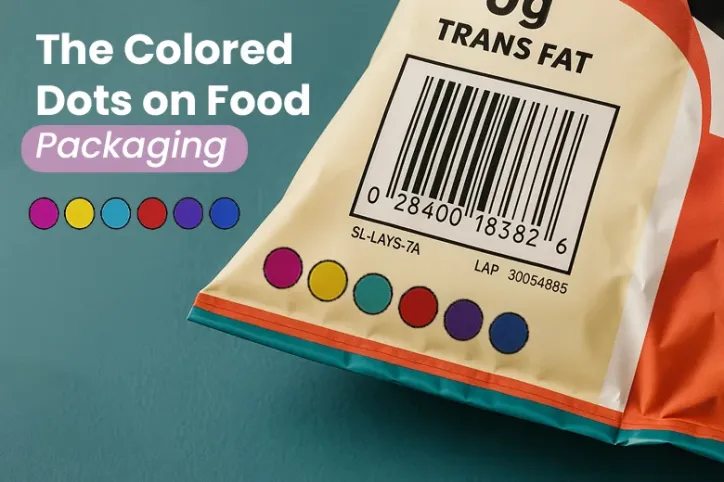

Have you ever noticed colored dots on food packaging, like red, blue, yellow, or black? You might have wondered what they mean. Are the color dots safety indicators? Do they relate to the food’s ingredients? These dots are important in food packaging, but their purpose is often misunderstood. Understanding the different dots can help streamline design and avoid confusion. Let’s explore whether the colored dots on the food packaging are connected to the consumer or the product.
What Do the Colorful Dots on Food Packages Mean?
The colored dots on food packaging are not decorative and have nothing to do with freshness, ingredients, or the product itself. These dots or colored squares represent different ink colors and help printers in various ways.
Understanding what food packaging is and its technical details helps you trust what you buy and know how it’s protected.
Each technical detail on packaging, even the ones we ignore, serves a specific and functional purpose.
Process Control Patches and CMYK Colors
The colorful dots, also called process control patches, are used to observe print quality. Mostly, the food packaging labels, wrappers, sheets, and other materials are printed in the flexography printing technique using the color model
- Cyan—a shade of blue
- Magenta—a shade of pink/red
- Yellow—the standard yellow ink
- Key/Black—black ink for depth and detail
How Printers Use These Dots
- Technicians or automated sensors inspect the dots during printing.
- They check for color accuracy. Whether each hue is too light, too dark, or if any printing element is misaligned or misplaced.
- Misaligned or faded colors can be corrected immediately, preventing mistakes across an entire batch.
- Ensures consistent branding and design quality for every package.
- They are completely unrelated to the food inside and are harmless.
These small marks are an essential part of the printing process, helping your favorite brands maintain a professional look on every box, bag, or wrapper.
Meaning of Each Colored Dot in Food Packaging

Not all colored dots on food packaging are the same. Each one has a specific role in the printing process. These dots act as guides for printers to ensure that colors are applied correctly, aligned perfectly, and consistent across every package.
By checking these marks, printers can catch any mistakes early and maintain the exact shades required for the brand’s design. These dots are purely technical tools for quality control and have no connection to the food inside.
- Blue or Cyan Dots: Helps produce blues, greens, and purples.
- Red or Magenta Dots: Used for reds, pinks, and purples.
- Yellow Dots: Combines with other inks to create bright shades and secondary colors.
- Black or Key Dots: Provides depth, text, and outlines.
- Green Dots: A mix of cyan and yellow; checked for correct shade.
- Purple Dots: A mix of cyan and magenta; ensures consistent purple tones.
- Orange Dots: A mix of magenta and yellow; verifies correct orange shades.
What does it mean if food packaging doesn’t have these colored dots?
Now that you know what the colors on the food packaging mean, it’s a good practice to pay attention to the placement of dots so they don’t lead to misconceptions.
But not every package displays these colored dots openly. They may be cut off sometimes, printed within sealed flaps, or concealed.
That depends on the die-cut or folding of the packaging. In some cases, colored dots can be concealed from consumer-facing designs. But the absence isn’t an indication of low quality—it’s simply a packaging design preference.
Colored Dots Across Different Packaging Types
Small colored dots appear on different types of food packaging, including wrappers, labels, and Mylar bags, for specific technical purposes. On printed packaging surfaces, these dots are the printer’s color-control marks used to maintain consistent CMYK colors across large production runs.
On canned foods, similar dots act as manufacturing codes, helping track production lines, batches, or machines for quality control.
While important for production and quality assurance, these dots do not affect the food inside and are not consumer indicators.
However, in some cases, brands use multiple colors to communicate different messages. For instance, red color instantly symbolizes heat or spice, orange for mild spice, green for vegetarian, etc.
Other Symbols on Food Packaging
While colored dots are not meant for consumers, other symbols are extremely important for food safety and product selection. Hence, as a food brand, you should also pay attention.
So, what other symbols should you pay attention to on food packaging?
| Symbol | Consumer Meaning |
| Green / Red square | Vegetarian or Non-Vegetarian food |
| Expiry / Best Before Date | Shelf life and freshness |
| Allergen Disclosure | Crucial for allergy sufferers |
| Barcode / QR Code | Traceability and ingredient transparency |
| Recycling Logo | Environmental and disposal information |
In Summary
The colored dots or circles on food packaging are known as process control patches or printer’s color blocks. These marks are used during printing to check color accuracy, ink alignment, and quality consistency. Whether you spot a black dot, red circle, or multi-colored strip, it’s a tool to ensure your product’s branding and labels print correctly.
When designing the right food packaging, you should ensure it’s compliant, informative, and visually appealing. To make it easier, you should consider working with us.
FAQs
What do the colorful dots on food packages mean?
The colorful dots are printer’s marks used to check that the colors on the packaging are correct. They help printers make sure the design is bright, aligned, and consistent on every package.
Why do wrappers have colored dots?
Wrappers have these dots so printers can monitor color quality during production. They show if the ink is too light, too dark, or misaligned.
What does the black/red/blue dot on food packaging mean?
These dots represent different printing inks: black for text or outlines, red for magenta, and blue for cyan. They are only for printing checks and have nothing to do with the food itself.
What’s the meaning of colored dots on the bottom of cans?
The colored dots on the bottom of cans are industrial marks used to track production lines or machines for quality control.
What if food packaging doesn’t have colored dots?
If a package doesn’t have colored dots, it usually means the printer didn’t include visible control marks, or they were trimmed after printing. The food inside is still safe and unchanged.
What do the colored dot stickers represent on each prepped protein item?
The colored dot stickers on prepped protein items are there to trace the type of protein. This helps the kitchen staff to quickly identify what is in the pack without opening it. For example. Red for raw meat, blue for fish, white for dairy products, green for vegetables, yellow for poultry, etc.
