

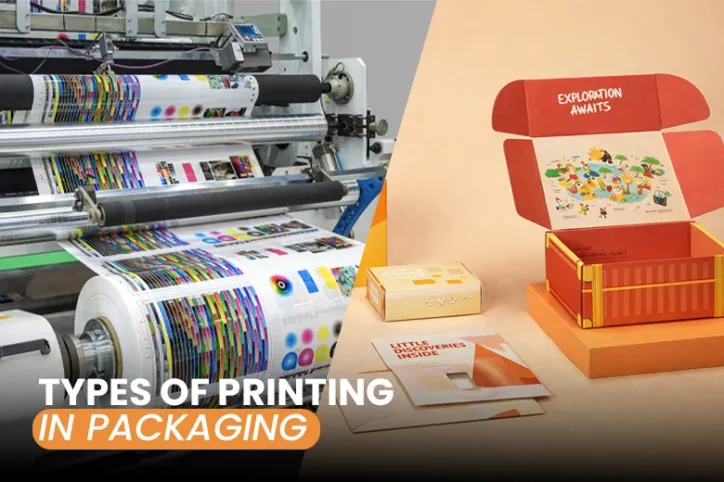

Packaging is usually the first physical interaction customers have with your products. Before they touch it, open it, or use it, they form a clear perception just by holding the package.
That moment of visual contact influences trust, quality, and even purchasing decisions. The center of the whole experience is one major characteristic that is often overlooked or not properly addressed: printing.
Printing is not simply about placing ink on a box. It affects how colors appear under certain conditions. In-store lighting and daylight will affect how finishes respond to handling, how text remains readable after shipping, and how well the branding stays consistent across thousands of units. Choosing the wrong printing method can lead to faded designs, unnecessary costs, or packaging that fails to match the product inside.
This guide breaks down all major printing types used in packaging, explains how each works, where it performs best, and what practical role it plays in real-world packaging production. This type of information is essential for achieving accuracy across every corner of your marketing and branding strategies.
Why Printing Method Matters in Packaging
When you see a product from a distance, the printed artwork on it is one of the reasons your brain provokes you to pick it up. Every printing technique behaves differently. Sometimes, taking an uninformed decision leads to poor results, even creating the impression of a fake product. The factors on which it relies are
- The packaging material
- The surface texture
- The production quantity
- The level of design detail
- The environment the box will face (shipping, storage, retail display)
To understand this factor more clearly, consider a rigid box printed by offset printing. It will deliver a very different outcome than a corrugated shipping carton printed precisely with the flexographic method.
Understanding these differences and what works well on which material helps businesses align packaging quality with product value and budget realities.
Different Printing Methods in Packaging
There are multiple printing techniques used in the packaging industry that have also changed compatibility with CMYK and PMS color schemes. Each of them has its unique uses and benefits that act differently on different materials. Some of them are discussed here.
Digital Printing
Digital printing is a modern printing method in which designs are transferred directly from a digital file (such as a PDF or image) onto packaging material, without using traditional printing plates. It’s ideal for short runs, personalized packaging, prototypes, and products that require variable designs or numbering.
Process or how this printing works
- The artwork file intended for printing is sent directly to a digital printer.
- Inkjet or toner technology applies directly to the packaging surface.
- Each sheet is printed individually.
- No drying delay is required before finishing.
Advantages of digital printing for packaging
- Fast and flexible setup
- Cost-effective for small to medium runs
- Ideal for personalized or seasonal designs
- High-quality, precise color reproduction on certain materials
- Designs can be modified easily.
Limitations
- Can work more slowly for very large runs compared to other alternatives
- Slightly higher cost per unit for bulk orders
- Limited specialty ink or coating options
Flexographic Printing
Flexographic printing, often called flexo, is a common, high-speed relief printing method. This means it uses flexible rubber or photopolymer plates to transfer ink onto a variety of materials, including paperboard, cardboard, plastic, and foil. Flexography is ideal for large runs, simple designs, and continuous patterns, such as labels, animations, and food packaging.
Process or how this printing works
- Here again, the artwork is created digitally and separated into individual color layers.
- Flexible plates are created using photopolymer or rubber.
- Only the designed area is raised, and where there is no design or blank spaces, they are recessed.
- Plates are then mounted on cylindrical rollers in the press.
- Fast-drying water-based, UV, or solvent-based inks (with some chemicals) are prepared.
- The printing press is set with all the plates on separate rollers.
- Anilox rollers (metal cylinders with tiny cells) control ink transfer to the plate.
- The printed material is continuously fed into the press from one end.
- Ink is transferred from the anilox roller to the raised parts of the plate.
- Each color is applied in sequence using CMYK schemes.
- As soon as the printed surface comes out, it is dried using air dryers, UV lamps, or infrared systems.
Advantages of flexography printing for packaging
- Advantages of Flexographic Printing
- High speed, cost-effective for large volumes
- Works on diverse materials, including flexible films
- Can use a variety of inks and finishes
- Durable and suitable for continuous patterns or solid colors
- Plates can be reused, reducing the cost of repeated runs.
Limitations
- Less precise for every fine detail as compared to digital or offset
- Initial plate setup can be time-consuming and costly for small runs.
- Color accuracy can be slightly varied on textured or ink-absorbent surfaces.
Rotogravure Printing
Rotogravure printing, also called gravure printing, uses metal cylinders with tiny grooves (engraved) to hold ink and roll it onto packaging materials. The cylinder rotates while the packaging passes under it, transferring the ink to give clear results. The machine uses rollers to supply ink and to remove excess ink.
Process or how it works
- The design is created digitally, and each color is separated.
- Then a transparent film or stencil is made for each color.
- The metal cylinder is then coated with a light-sensitive layer.
- The film is placed on the cylinders and exposed to light.
- The design will remain on the cylinders, and the rest of the soft areas will be washed away, leaving tiny grooves to hold ink.
- Ink is applied to the cylinder, and a doctor blade removes the excess.
- Packaging material is passed between two cylinders: the gravure cylinder (with the ink and film) and the impression roller (for applying the correct pressure).
Advantages
- High-quality images
- Consistent color across long production runs
- Can print on a wide range of materials
- Allows continuous patterns
Limitations
- High initial cost for the cylinder setup
- Not a budget-friendly option for short runs
- Slower setup time compared to digital and flexo printing.
Offset Printing
Offset printing is a commercial printing process that works on the principle of lithographic printing. Here, an oil-based inked image is transferred from a chemically treated metal plate to a rubber blanket and then onto the material substrate. The process uses oil-based inks to cover the image areas and water to cover non-image areas of the plates. This widely used method relies on the natural repulsion between oil and water to produce a clean and sharp print.
Process or how it works
- The artwork is split into CMYK colors, each with its own plate.
- The design for each color is transferred onto a metal plate, either using a transparent film or directly from a digital file.
- On the plate, image areas attract ink (oleophilic) and non-image areas attract water (hydrophilic).
- Water repels the oil-based ink, so it sticks only to the image areas, leaving the non-image areas clean.
- Plates are mounted on cylinders in the press.
- Water is applied to the non-image areas.
- Ink is applied to the image areas.
- The inked image moves from the plate to a rubber blanket.
- Paper passes between the blanket and the cylinder, picking up the image.
- Paper passes through units for all colors to form the full image.
- Ink dries, and the paper can then be cut, folded, laminated, or finished.
In offset printing, the plate has image areas that should receive ink and non-image areas that should stay blank. Water is applied to the non-image areas, and because oil-based ink and water repel each other, ink sticks only to the image areas. This keeps the non-image areas clean, ensuring sharp and precise prints.
Advantages
- Produces high-quality, sharp, and consistent prints.
- Works well on a wide range of surfaces, including paper, cardboard, and some plastics.
- Cost-effective for large print runs, as the per-unit cost decreases with quantity.
- Can handle fine details, images, and text accurately.
- Colors are stable and vibrant, especially for CMYK and spot colors.
Limitations
- High initial setup cost due to plates and press preparation.
- Not economical for small print runs.
- Slower turnaround compared to digital printing.
- Requires skilled operators to manage color registration and press setup.
- Changing designs mid-run is difficult, as new plates must be made.
Screen Printing
Screen printing is a versatile method suitable for a wide range of applications and can be used on many materials, including fabric. Here, a mesh screen is used to transfer ink onto a surface. A stencil blocks the area where ink should not go, and ink is pushed through the open areas of the mesh onto the material below. It works on the principle of forcing ink through a stencil-covered screen using a squeegee.
Process or how it works
- The artwork is created and separated for each color.
- The screens are then prepared with mesh traditionally made of silk or polyester. It is coated with a light-sensitive emulsion.
- The negative film on which the design (stencil) is placed on the mesh screen is exposed to UV light, which hardens the emulsion where the design should be blocked. The unexposed areas are washed away, leaving open mesh through which ink can pass.
- The screen is placed on the material to be printed (paperboard, cardboard, fabric, plastic, etc.)
- Ink is poured onto the screen, and a squeegee is used to push it through the open mesh areas onto the surface.
- For multi-color prints, each color required a separate screen. So when the first color is fully applied, it is dried, then placed back onto the substrate for the next color using the same technique.
Advantages
- Can print on almost any surface, including paper, plastic, glass, metal, and fabric.
- Produces vivid, thick, and durable colors that last long.
- Works well for small to medium runs and customized designs.
- Ideal for bold graphics, logos, and text.
- Allows specialty inks (metallic, glow-in-the-dark, textured) for creative effects.
Limitations
- Fine details and photo-like images are harder to achieve.
- Multicolor designs require separate screens and careful alignment, which increases time and cost.
- Slower than some digital printing methods for high-volume jobs.
- Setup requires skill and screen preparation, making short-run printing slightly labor-intensive.
- The ink layer is thicker, so it may not be suitable for very thin or flexible materials in some cases.
A Quick Overview of Printing Techniques
| Printing Techniques | Suitable Quantities | Print Quality | Color Accuracy |
| Offset | Large/bulk runs | Sharp, precise, fine details possible | Stable and consistent CMYK/spot colors |
| Digital | Small to medium runs | High for short runs, slightly less sharp for very large runs | Very good, full color easily |
| Screen | Small to medium runs; scalable with more efforts | Bold, thick, fine photo-like details hard to achieve | Very vibrant specialty inks are possible |
| Gravure | Supports very large runs | Extremely high, excellent for fine details | Sharp, vivid, consistent |
| Flexo | Medium to very large runs | Good, slightly less sharp than offset | Printable to many surfaces |
Which Type of Printing Method Is Best for Packaging Boxes?
Selecting the right printing method for your packaging boxes often depends on factors such as material type, design complexity, run size, desired finish, and quantity. Each printing technique has its own strengths and weaknesses.
- Offset printing is ideal for large-volume runs on cardboard and paper cards. It results in sharp, precise prints and handles fine details well. Additionally, it is perfect for the products where consistent color and high-quality images are important.
- Digital printing is best for small to medium runs or when customization is required. It allows for quick turnaround and is cost-effective for short runs. However, it is not as accurate as offset on certain materials; when printing large batches, it is preferred.
- Screen printing is excellent for bold graphics and for creating special effects such as metallic, textured, and glow-in-the-dark inks. It can print on a variety of materials, including cardboard, plastics, and fabrics, offering durable, vibrant results.
- Gravure printing is suitable for very large runs, especially on flexible packaging films. It delivers extremely high-quality, detailed prints with consistent color.
- Flexographic printing is preferred for medium to very large runs on corrugated boards, cartons, and other packaging materials. It’s fast, versatile, and works well on textured or uneven surfaces.
It is also crucial to consider the color management when going to print your stuff. Most packaging uses CMYK (Cyan, Magenta, Yellow, Black) for full-color printing, while others use PMS (Pantone Matching System) for spot colors that work well for logos or key brand elements. In many cases, brands combine both. CMYK for full-color images and PMS for key brand elements. Ultimately, the right technique, combined with a balanced palette and tones, will yield the best results.


