

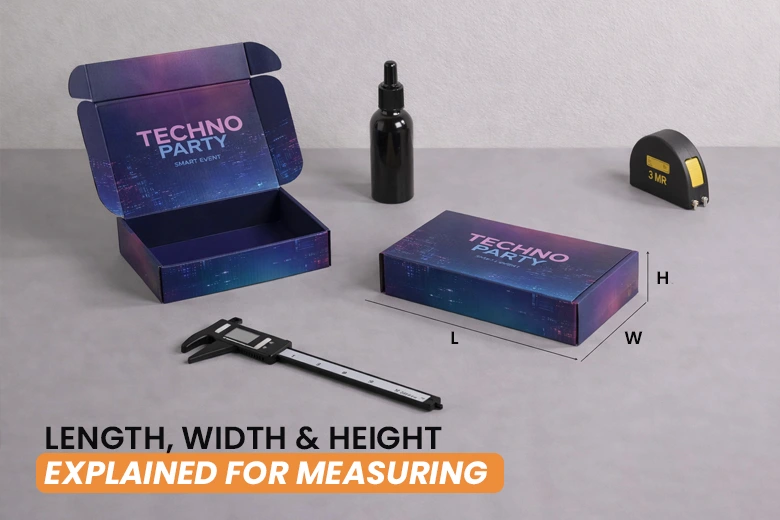

Understanding the basics of box dimensions can lead you to successful packaging. Imagine your products arrive, and as soon as you open the box, you see damaged and cracked pieces. This is what an oversized box can do.
What’s even worse? A tight packaging that will keep your products inside, and access will be difficult. This is why, before ordering your custom boxes, it is important to learn about the units of measurement for accurate results.
What Are Length, Width & Height?
Length, width, and height describe an object’s size from different directions. People use these units to measure the dimensions of different boxes and bags. It also analyzes how much space a certain object takes and whether it fits in a certain place.
Length
Length is the longest side of the box. It measures how far the box stretches from one end to the other and indicates its longest dimension.
Width
Width is the shorter side of the box, next to the length. It measures how wide the box is from side to side and shows the space the box occupies across its shorter dimension.
Height
Height, also called depth, is the side of the box that extends straight up from the bottom to the top. It measures how tall the box stands and how much vertical space it takes.
How to Perfectly Measure the Volume of a Box
Knowing a box’s volume helps determine how much space it contains and how much product it can hold. Volume is measured when you know the length, width, and height of a box.

Step 1
Place the box on a flat surface. Measure the longest side for length, the shorter side for width, and the vertical side for height. Make sure the tape or measuring tool is aligned with the edge of the box and is straight, not bending.
Step 2
As soon as you have the accurate measurements of length, width, and height, multiply them together to get the volume. Its simple formula will be
Length × Width × Height = Volume
For example, if a box measures 12 × 8 × 3 inches, it has 288 cubic inches
This number shows the total space inside the box.
Step 3
Now, you can use these measurements and their results for practical decisions. For instance, check whether your product fits comfortably in the box, how much padding or inserts you might need, or whether you can compare shipping costs, as many delivery services charge based on volume for light and bulky boxes.
Measuring volume ensures the right box is chosen for your product, prevents wasted space, and helps avoid shipping surprises.
How to Measure Inside Dimensions of a Box

After thoroughly understanding how to measure a box externally, measuring it internally is also essential, especially if you are a packaging manufacturer or packing a fragile item.
Measuring the inside of a box shows how much space is actually available for your product. However, to find the ideal box size, consider measuring the product as well.
Accurate inside measurements help you pick the right box, plan padding, and know how much your product can move inside.
- Place the box on a flat surface so it sits steady.
- For inside length, put the tape measure at one inside corner along the longest side of the box and stretch it straight to the opposite corner on the same side.
- For inside width, place the tape measure at one inside corner along the shorter side of the box and stretch it straight across to the opposite corner on that side.
- For inside height (depth), place the tape measure at the bottom inside the box and extend it straight up to the top edge, and note down the readings.
Example: A gift box that is 10 × 8 × 4 inches externally may measure 9.5 × 7.5 × 3.8 inches internally, showing exactly how much space is available for the product.
Why Length, Width, and Height Matter
Length, width, and height are the three measurements used because together they describe the 3D space of an object. In real life, we see custom packaging boxes everywhere. Each one of them has different measurements and occupies different spaces.
Calculating them precisely will help you in multiple ways, especially if you are the manufacturer. For instance, if the dimensions of a cereal box are incorrect, the contents may spill out.
Similarly, if you run a food chain, you need to know the exact dimensions of your product and decide which box is the best fit.
Examples include pizza box sizes, burger boxes for unique settings, French fries packaging, etc. Each one shows a different direction of space. To simplify it, consider.
- Length shows how long the box is from one side to the other.
- Width shows how wide the box is across the shorter side.
- Height shows how tall the box stands from bottom to top.
FAQs
How do you measure the dimensions of a box?
Measure the longest side for length, the shorter side for width, and the vertical side for height. Keep the tape flat against the box and record each measurement carefully.
What is the correct order for box dimensions?
Always use Length × Width × Height. Length is the longest side, width is the shorter side next to it, and height measures the vertical space.
What comes first: height, length, or width?
Length always comes first, followed by width, and then height. Even if the top of the box is square, the first number is always called the length to follow the standard.
What’s the difference between internal and external box dimensions?
Internal dimensions show the usable space inside the box for your product, while external dimensions show the space the box occupies for shipping or storage.
Can height be called depth?
Yes, some suppliers use the word depth instead of height, but it always refers to the vertical measurement from the bottom to the top of the box.
How do I calculate the volume of a box?
Multiply Length × Width × Height to find the volume, which shows how much space is inside the box for your product or packing material.
How does dimensional (DIM) weight affect shipping cost?
Shipping carriers sometimes charge based on the box’s volume rather than just its weight, so larger boxes that are light can cost more to ship.
How much space should I allow for padding or inserts?
Leave extra room inside the box so products fit safely, and cushioning like bubble wrap or foam can prevent damage during transport.
What tools should I use to measure a box?
A tape measure, ruler, or caliper works well, and measurements should be straight, consistent, and recorded in the correct order.
Why are dimensions written in L × W × H format?
This standard order prevents confusion, ensures clear communication with suppliers, and makes shipping and storage calculations easier.
Should dimensions include flaps?
No, measurements should only use the actual box walls, not flaps or lids, to get accurate internal or external dimensions.